<?xml version="1.0" encoding="UTF-8"?><rss version="2.0"
	xmlns:content="http://purl.org/rss/1.0/modules/content/"
	xmlns:wfw="http://wellformedweb.org/CommentAPI/"
	xmlns:dc="http://purl.org/dc/elements/1.1/"
	xmlns:atom="http://www.w3.org/2005/Atom"
	xmlns:sy="http://purl.org/rss/1.0/modules/syndication/"
	xmlns:slash="http://purl.org/rss/1.0/modules/slash/"
	>

<channel>
	<title>Createquity.Createquity.</title>
	<atom:link href="https://createquity.com/author/shawnlent/feed/" rel="self" type="application/rss+xml" />
	<link>https://createquity.com</link>
	<description>The most important issues in the arts...and what we can do about them.</description>
	<lastBuildDate>Wed, 15 Jul 2020 20:17:39 +0000</lastBuildDate>
	<language>en-US</language>
	<sy:updatePeriod>hourly</sy:updatePeriod>
	<sy:updateFrequency>1</sy:updateFrequency>
	<generator>https://wordpress.org/?v=6.9.4</generator>
	<item>
		<title>Come Feast on Some Knowledge With Us</title>
		<link>https://createquity.com/2017/07/come-feast-on-some-knowledge-with-us/</link>
		<comments>https://createquity.com/2017/07/come-feast-on-some-knowledge-with-us/#respond</comments>
		<pubDate>Mon, 17 Jul 2017 11:44:22 +0000</pubDate>
		<dc:creator><![CDATA[Shawn Lent]]></dc:creator>
				<category><![CDATA[Announcements]]></category>
		<category><![CDATA[Boston]]></category>
		<category><![CDATA[Createquity]]></category>
		<category><![CDATA[public programming]]></category>
		<category><![CDATA[retreat]]></category>

		<guid isPermaLink="false">https://createquity.com/?p=10184</guid>
		<description><![CDATA[Meet our editorial team in Boston next month for a morning of learning and conversation about the arts ecosystem.]]></description>
				<content:encoded><![CDATA[<p>Each year since 2013, Createquity has taken a moment to gather its globally dispersed editorial team all in one place for an intense session of planning, discussion, and camaraderie. The 2017 Createquity annual retreat will take place in Boston, Massachusetts, and to celebrate, we’d like to invite you to a presentation and discussion of what Createquity has learned from our efforts to understand the arts ecosystem over the past three years – and what we&#8217;ve learned about learning itself. Please join us for:</p>
<p><strong>(Brain) Power Breakfast with Createquity</strong><br />
Monday, August 7, 2017<br />
9:30 &#8211; 11:00 AM<br />
Northeastern Crossing<br />
1175 Tremont Street<br />
Boston, MA 02120</p>
<p><em>Northeastern Crossing is easily accessible via the Ruggles MBTA Station. </em><em>More specific directions to the venue are available <a href="https://www.northeastern.edu/crossing/contact/locations-directions/" target="_blank">here</a>.</em></p>
<p>The program will include introductory remarks from Createquity, the official presentation of the first-ever winner of the <a href="https://createquity.com/2017/06/the-createquity-arts-research-prize-is-coming-soon/">Createquity Arts Research Prize</a> (!!), and a series of lightning presentations summarizing and synthesizing Createquity&#8217;s in-depth research on a number of pressing issues in arts and culture. Afterwards, we will host a facilitated discussion inviting audience members to reflect on what we&#8217;ve learned about the arts ecosystem, what we still need to know, and how we might go about building that knowledge. Ample time for networking and complimentary coffee and pastries will be provided.</p>
<p><strong><a href="https://www.artful.ly/store/events/12744" target="_blank">Please RSVP</a> by 8/1. </strong></p>
<p>The event is free with <a href="https://createquity.com/donate/" target="_blank">donations</a> encouraged.</p>
]]></content:encoded>
			<wfw:commentRss>https://createquity.com/2017/07/come-feast-on-some-knowledge-with-us/feed/</wfw:commentRss>
		<slash:comments>0</slash:comments>
		</item>
		<item>
		<title>The State: A Friend Indeed to Artists in Need?</title>
		<link>https://createquity.com/2016/07/the-state-a-friend-indeed-to-artists-in-need/</link>
		<comments>https://createquity.com/2016/07/the-state-a-friend-indeed-to-artists-in-need/#comments</comments>
		<pubDate>Fri, 08 Jul 2016 11:31:16 +0000</pubDate>
		<dc:creator><![CDATA[Shawn Lent, Michael Feldman, Talia Gibas and Louise Geraghty]]></dc:creator>
				<category><![CDATA[Analysis]]></category>
		<category><![CDATA[arts careers]]></category>
		<category><![CDATA[economic disadvantage and the arts]]></category>
		<category><![CDATA[government funding]]></category>
		<category><![CDATA[individual artists]]></category>
		<category><![CDATA[international]]></category>
		<category><![CDATA[international arts funding]]></category>
		<category><![CDATA[socioeconomic status]]></category>
		<category><![CDATA[State sponsorship]]></category>

		<guid isPermaLink="false">https://createquity.com/?p=9169</guid>
		<description><![CDATA[Internationally, governments can play an important role creating occupational equity for the arts - but there’s a catch.]]></description>
				<content:encoded><![CDATA[<p>From <a href="http://www.culturalpolicies.net/web/azerbaijan.php?aid=21" target="_blank">Baku</a> to <a href="http://www.unesco.org/new/en/unesco/worldwide/africa/central-african-republic/" target="_blank">Bangui</a>, Boston to Bangkok, we need a diverse, equitable world of cultural voices for our times. Createquity imagines that a <a href="https://createquity.com/about/a-healthy-arts-ecosystem/" target="_blank">healthy arts ecosystem</a> is one in which opportunities to make one’s living as an artist are distributed equitably across socioeconomic levels. Unfortunately, that does not seem to be the case in many western countries, where research indicates that people of lesser means are not as equipped to take on <a href="https://createquity.com/2016/06/who-can-afford-to-be-a-starving-artist/" target="_blank">the risk</a> involved in pursuing a career in the arts.</p>
<p>Around the world, we see people facing challenges not only accessing careers as artists, but also sustaining them. <a href="https://www.theguardian.com/culture-professionals-network/2015/jan/12/artists-low-income-international-issues" target="_blank">South Korean artists make 77% and Canadian artists 74%</a> of their respective countries’ average income. In Ireland, <a href="http://ifacca.org/en/news/2016/05/19/visual-artists-ireland-calls-government-immediate/" target="_blank">80% of visual artists</a> who depend on their creative income live in poverty. One survey respondent in that country describes the outlook for artists this way: “The future always looks worse than the past. Economic booms are quite bad for artists, because they <a href="http://www.artscouncil.ie/uploadedFiles/LWCA_Study_-_Final_2010.pdf" target="_blank">can&#8217;t afford to live where they should</a> for their careers. Busts are worse.”</p>
<p>Generally, people born into less affluence have to <a href="http://www.smithsonianmag.com/smart-news/10000-hour-rule-not-real-180952410/?no-ist" target="_blank">work harder</a> to catch up in any field. The Guardian’s Sonia Sodha writes that “we’ll never be able to eliminate the role that good fortune plays, but we need to <a href="http://www.theguardian.com/commentisfree/2016/may/01/only-successful-people-can-afford-cv-of-failure" target="_blank">do much more to lessen its influence</a> and increase the relationship between effort and success.” What role can government play in lessening the influence of fortune when it comes to supporting artists? A look at several countries gives us some clues.</p>
<div id="attachment_9177" style="width: 460px" class="wp-caption aligncenter"><a href="https://flic.kr/p/Lt3RA"><img fetchpriority="high" decoding="async" aria-describedby="caption-attachment-9177" class="wp-image-9177" src="https://createquity.com/wp-content/uploads/2016/07/503203452_ffb290fbef_b-1024x683.jpg" alt="Tran Thi Doanh, painter - Photo by Flickr user, Duc" width="450" height="300" srcset="https://createquity.com/wp-content/uploads/2016/07/503203452_ffb290fbef_b.jpg 1024w, https://createquity.com/wp-content/uploads/2016/07/503203452_ffb290fbef_b-300x200.jpg 300w, https://createquity.com/wp-content/uploads/2016/07/503203452_ffb290fbef_b-768x512.jpg 768w" sizes="(max-width: 450px) 100vw, 450px" /></a><p id="caption-attachment-9177" class="wp-caption-text">Tran Thi Doanh, Vietnames painter &#8211; Photo by Flickr user, Duc</p></div>
<p>&nbsp;</p>
<h2><b>Two Models: National Status vs. Sink or Swim </b></h2>
<p>In some countries, including the United States, being an artist doesn’t necessarily mean having a professional artist career track, especially not in any sort of state-sponsored system. As one national study of artists reported, “some painters interviewed said that <a href="https://www.arts.gov/sites/default/files/NEA-Research-Report-37.pdf" target="_blank"><i>career</i> was not part of their professional vocabulary</a>; they simply <i>were painters</i>.” In that context, <a href="https://createquity.com/2016/06/who-can-afford-to-be-a-starving-artist/" target="_blank">as we’ve explored</a>, many US-based artists have day jobs and backup plans, and find themselves <a href="http://www.haassr.org/wp-content/uploads/2014/05/caCrossover.pdf" target="_blank">crossing between nonprofit and commercial sectors</a> in a demanding market economy.</p>
<p>In other parts of the world such as in the former Soviet Union, as scholar Nina Dimitrialdi describes in her 2009 PhD dissertation on challenges faced by US and UK artists, <a href="https://www.zotero.org/groups/createquity/items/collectionKey/GXJVFHWS/itemKey/HV7Q59T8" target="_blank">“artist” was indeed a profession</a> just like any other. An artist in the Russian Federation with “professional” status from the government currently receives compulsory social programs such as insurance covering <a href="http://portal.unesco.org/culture/en/ev.php-URL_ID=33176&amp;URL_DO=DO_TOPIC&amp;URL_SECTION=201.html" target="_blank">illness, housing, maternity, disability, and retirement</a>. Many countries with cultural sectors based on the old Soviet model, such as <a href="http://egyptartsacademy.kenanaonline.com/" target="_blank">Egypt</a>, fully bankroll training programs and manage “card carrying” artists and their benefits through a national union.</p>
<div id="attachment_9170" style="width: 415px" class="wp-caption aligncenter"><img decoding="async" aria-describedby="caption-attachment-9170" class=" wp-image-9170" src="https://createquity.com/wp-content/uploads/2016/07/Screen-Shot-2016-07-04-at-4.21.21-PM.png" alt="Left: Egypt’s High Institute of Ballet, 2013 (conditions under Presidents Mubarak, Mansour and Morsi) | Right: Same facility in 2016 (under President ElSisi) - Images by Shawn Lent and Madga Saleh" width="405" height="401" srcset="https://createquity.com/wp-content/uploads/2016/07/Screen-Shot-2016-07-04-at-4.21.21-PM.png 486w, https://createquity.com/wp-content/uploads/2016/07/Screen-Shot-2016-07-04-at-4.21.21-PM-150x150.png 150w, https://createquity.com/wp-content/uploads/2016/07/Screen-Shot-2016-07-04-at-4.21.21-PM-300x298.png 300w, https://createquity.com/wp-content/uploads/2016/07/Screen-Shot-2016-07-04-at-4.21.21-PM-32x32.png 32w, https://createquity.com/wp-content/uploads/2016/07/Screen-Shot-2016-07-04-at-4.21.21-PM-64x64.png 64w, https://createquity.com/wp-content/uploads/2016/07/Screen-Shot-2016-07-04-at-4.21.21-PM-96x96.png 96w, https://createquity.com/wp-content/uploads/2016/07/Screen-Shot-2016-07-04-at-4.21.21-PM-128x128.png 128w" sizes="(max-width: 405px) 100vw, 405px" /><p id="caption-attachment-9170" class="wp-caption-text">Left: Egypt’s High Institute of Ballet, 2013 (conditions under Presidents Mubarak, Mansour and Morsi) | Right: Same facility in 2016 (under President el-Sisi) &#8211; Images by Shawn Lent and Madga Saleh</p></div>
<p>Whether or not artistry is a formal profession in the eyes of the state, and what states do or don’t do to support that profession, reflects <a href="http://worldcp.org/index.php" target="_blank">different agendas within different political systems</a>. While the <a href="https://www.arts.gov/sites/default/files/how-the-us-funds-the-arts.pdf" target="_blank">American model mostly distributes public funding for the arts indirectly</a>, via tax deductions for nonprofit organizations and their donors, many other governments provide substantial direct support to individual artists. Increased overall <a href="https://createquity.com/2012/05/is-federal-money-the-best-way-to-fund-the-arts/" target="_blank">government funding for the arts</a> could be an important indicator of potential support for economically disadvantaged artists, but there is an opportunity in cultural policy to assess what funding schemes help bridge wealth gaps in the profession.</p>
<p>Unfortunately, we found existing research on this topic to cover predominantly North American and European countries, with few nationally representative results relating to artists from poorer backgrounds. While it is difficult to get a good read on the situation internationally, in many parts of the world, it does appear that dedicated government support – in the forms of subsidies and other incentives – has opened the artistic profession to more people across social classes.</p>
<div id="attachment_9172" style="width: 443px" class="wp-caption aligncenter"><a href="https://flic.kr/p/jDn15L" rel="attachment wp-att-9172"><img decoding="async" aria-describedby="caption-attachment-9172" class="wp-image-9172" src="https://createquity.com/wp-content/uploads/2016/07/12237229804_0bee3e60c1_k-1024x768.jpg" alt="Europe Day Slovenia - Photo by Flickr user, Steve" width="433" height="325" /></a><p id="caption-attachment-9172" class="wp-caption-text">Europe Day Slovenia &#8211; Photo by Flickr user, Steve</p></div>
<p>&nbsp;</p>
<h2><b>Public Policy Can Keep Artists Afloat</b></h2>
<p>We see a number of countries enacting support programs for artists that are tied in with their tradition of centralized social services, supporting the basic needs of all citizens; this could be critical for artists and similar types of workers. As Quartz’s Aimee Groth put it when speaking about entrepreneurs, &#8220;<a href="http://qz.com/455109/entrepreneurs-dont-have-a-special-gene-for-risk-they-come-from-families-with-money/" target="_blank">when basic needs are met, it&#8217;s easier to be creative.</a>&#8221; By giving more of a safety net to artists born with less means, government programs can make it easier for people (artists included) to risk being &#8220;<a href="https://createquity.com/2016/06/who-can-afford-to-be-a-starving-artist/" target="_blank">entrepreneurial</a>.&#8221;</p>
<p><a href="http://portal.unesco.org/culture/en/ev.php-URL_ID=40139&amp;URL_DO=DO_TOPIC&amp;URL_SECTION=201.html" target="_blank">Slovenia</a>, <a href="http://www.taike.fi/documents/10921/0/Heikkinen+26+03.pdf" target="_blank">Finland</a>, <a href="http://www.billboard.com/biz/articles/news/global/1305861/italys-enpals-extends-labels-pensions-deadline" target="_blank">Italy</a> and <a href="http://www.culturalpolicies.net/web/austria.php?aid=514" target="_blank">Austria</a> are a few of the many countries that offer pension and retirement programs to deserving artists as defined by those governments. The South Korean <a href="http://www.koreaherald.com/view.php?ud=20111102000634&amp;mod=skb" target="_blank">Artists Welfare Act</a> extends the country’s employment insurance to 180,000 artists and accident insurance to 57,000 artists. The Danish Arts Foundation’s <a href="http://www.kunst.dk/statens-kunstfond/om-statens-kunstfond/om-haedersydelser/" target="_blank">life-long benefit grants</a> (<i>livsvarige statsydelser</i>) are awarded to state-selected, high-achieving artists in that country. In Thailand artists employed by the Ministry of Culture are <a href="http://portal.unesco.org/culture/en/ev.php-URL_ID=33182&amp;URL_DO=DO_TOPIC&amp;URL_SECTION=201.html" target="_blank">considered civil service officers</a> with the same salary system and benefits, and in Germany, the Artists&#8217; Social Insurance Fund (<a href="http://www.kuenstlersozialkasse.de/" target="_blank"><i>Künstlersozialkasse</i></a> or<i> KSK</i>) has been supporting self-employed artists and journalists since 1983.</p>
<div id="attachment_9182" style="width: 460px" class="wp-caption aligncenter"><a href="https://flic.kr/p/6x7wS3" rel="attachment wp-att-9182"><img loading="lazy" decoding="async" aria-describedby="caption-attachment-9182" class="wp-image-9182" src="https://createquity.com/wp-content/uploads/2016/07/3633869710_6f6561ab2a_z.jpg" alt="Making an appointment with Sabine Schlüter, head of KSK (Künstlersozialkasse) - Photo by Flickr user, Henning Krause" width="450" height="300" srcset="https://createquity.com/wp-content/uploads/2016/07/3633869710_6f6561ab2a_z.jpg 500w, https://createquity.com/wp-content/uploads/2016/07/3633869710_6f6561ab2a_z-300x200.jpg 300w" sizes="auto, (max-width: 450px) 100vw, 450px" /></a><p id="caption-attachment-9182" class="wp-caption-text">2009 Making an appointment with Sabine Schlüter, head of KSK (Künstlersozialkasse) &#8211; Photo by Flickr user, Henning Krause</p></div>
<p><b>Estonia</b></p>
<p>Another country advancing its support of artists is <a href="http://www.kul.ee/en/news/artistic-unions-announced-competitions-artists-and-writers-salaries" target="_blank">Estonia</a>, where a select group of artists and writers are offered a €1005 salary per month for two years plus health insurance and a pension plan. According to Indrek Saar, Estonia’s Minister of Culture, “the purpose of [the program] is to offer for a couple of years a possibility to work in peace and social guarantees for the distinguished creative people. <a href="http://www.kul.ee/en/news/artistic-unions-announced-competitions-artists-and-writers-salaries" target="_blank">Economic stability of a creative person</a> gives better preconditions to create a new work of art.” This year Saar announced a <a href="http://www.kul.ee/en/news/minister-culture-signed-agreement-wages-cultural-professionals-2016" target="_blank">13.5% raise to the minimum wage</a> for cultural professionals in that country’s government. This program is quite similar to one in <a href="http://www.konstnarsnamnden.se/default.aspx?id=12154" target="_blank">Sweden</a>, where income guarantees are given to selected artists who have created work considered “<a href="http://www.thelocal.se/20100217/25048" target="_blank">important for Swedish cultural life</a>.”</p>
<p><b>Netherlands</b></p>
<p>The Netherlands has historically been a strong leader in this realm. The Dutch Artists’ Work and Income Scheme Act (<a href="http://wetten.overheid.nl/BWBR0017837/2011-07-01" target="_blank">WWIK</a>), in place from 2005-2012, was the third major artist subsidy program developed for the country. WWIK provided financial support (<a href="http://www.artscouncil.ie/uploadedFiles/LWCA_Study_-_Final_2010.pdf" target="_blank">70-125% of the guaranteed minimum income</a>) for artists with a low income for a maximum of 48 months over 10 years to cover the start-up period of their professional arts career. Dutch artists also received extensions in the availability of unemployment benefits (4 years rather than 6 months).</p>
<p>While that program did not track impact for artists from financial disadvantage, another example from the Dutch attempted to connect cause and effect. From the 1960s-80s, the Netherlands provided temporary assistance to low-income visual artists that allowed those artists to sell their work directly to local governments as a supplement to income. The number of participating <a href="https://www.zotero.org/groups/createquity/items/collectionKey/GXJVFHWS/itemKey/IG75AKWX" target="_blank">artists increased from 200 in 1960 to 3800 in 1983</a>. During the same period, the growth rate of student enrollment in fine arts departments at Dutch academies was 60% higher than the average growth rate for technical and vocational training in other fields.</p>
<div id="attachment_9173" style="width: 473px" class="wp-caption aligncenter"><a href="https://flic.kr/p/wwCDA" rel="attachment wp-att-9173"><img loading="lazy" decoding="async" aria-describedby="caption-attachment-9173" class=" wp-image-9173" src="https://createquity.com/wp-content/uploads/2016/07/345471524_1236657796_b-1024x686.jpg" alt="Members of Ethiopia's Ras Theatre group dance and play as they wait for Uganda's President Yoweri Museveni at Bole Airport, Addis Ababa - Photo by Flickr user, Andrew Heavens" width="463" height="310" srcset="https://createquity.com/wp-content/uploads/2016/07/345471524_1236657796_b.jpg 1024w, https://createquity.com/wp-content/uploads/2016/07/345471524_1236657796_b-300x201.jpg 300w, https://createquity.com/wp-content/uploads/2016/07/345471524_1236657796_b-768x515.jpg 768w" sizes="auto, (max-width: 463px) 100vw, 463px" /></a><p id="caption-attachment-9173" class="wp-caption-text">Members of Ethiopia&#8217;s Ras Theatre group dance and play as they wait for Uganda&#8217;s President Yoweri Museveni at Bole Airport, Addis Ababa &#8211; Photo by Flickr user, Andrew Heavens</p></div>
<h2></h2>
<h2><b>The Warning: Selling Out (or Buying In) for Survival</b></h2>
<p>Governments sponsor artists for a complex set of purposes: <a href="http://mkrf.ru/press-tsentr/novosti/ministerstvo/v-krymu-prokhodit-zasedanie-koordinatsionnogo-soveta-po-kulture-pri-minkultury-r" target="_blank">cultural tourism</a> like the kind Russia is planning in occupied Crimea; <a href="http://www.slate.com/articles/news_and_politics/roads/2015/05/cuba_s_rap_agency_the_cuban_hip_hop_community_s_awkward_relationship_with.html" target="_blank">income generation</a> or nationalism such as with the <a href="http://www.ecured.cu/Agencia_Cubana_de_Rap" target="_blank">Agencia Cubana de Rap</a> in Cuba; <a href="http://ifacca.org/en/news/2015/03/16/culture-minister-acts-protect-national-image/" target="_blank">protecting the national image</a> like in Vietnam; “<a href="http://worldcp.org/canada.php?aid=21" target="_blank">preserving the country&#8217;s national cultural assets</a> for the benefit of all citizens and future generations” including aboriginal arts like in Canada; <a href="http://www.mc.gov.md/en/content/minister-culture-had-meeting-ambassador-republic-china-republic-moldova" target="_blank">binational collaboration</a> such as that of China-Moldova; cultural diplomacy, placemaking, or improving public morale. Generally speaking, state-sponsored artists are expected to adhere to policies that align with national interests.</p>
<div id="attachment_9179" style="width: 460px" class="wp-caption aligncenter"><a href="https://flic.kr/p/h1LEbQ" rel="attachment wp-att-9179"><img loading="lazy" decoding="async" aria-describedby="caption-attachment-9179" class=" wp-image-9179" src="https://createquity.com/wp-content/uploads/2016/07/10510421676_b0057b9530_z.jpg" alt="2013 Venice Biennale / Maldives Pavilion - Photo by Flickr user, Emergency Room Thierry" width="450" height="300" srcset="https://createquity.com/wp-content/uploads/2016/07/10510421676_b0057b9530_z.jpg 640w, https://createquity.com/wp-content/uploads/2016/07/10510421676_b0057b9530_z-300x200.jpg 300w" sizes="auto, (max-width: 450px) 100vw, 450px" /></a><p id="caption-attachment-9179" class="wp-caption-text">2013 Venice Biennale / Maldives Pavilion &#8211; Photo by Flickr user, Emergency Room Thierry</p></div>
<p>Before we all make a rush on the Dutch consulate or start demanding new state-sponsored artist programs in our respective countries – quite the issue to float in our current political climate – it&#8217;s worth considering the pitfalls that can come with increased government involvement in the arts.</p>
<ul>
<li><b>Threats to Freedom of Speech: </b>Several of the programs mentioned above are or were careful to allow artistic freedom. The Netherlands supported the artists participating in its assistance programs regardless of the style or content of the work they produced. In Estonia, Minister Saar explains that artists receiving the government salaries are “still <a href="http://www.kul.ee/en/news/artistic-unions-announced-competitions-artists-and-writers-salaries" target="_blank">free in their creative work</a>; the only requirement for the creative person is the commitment to one’s creative work.” Unfortunately, such freedoms are the exception rather than the rule. Many countries, such as <a href="http://worldcp.org/zimbabwe.php?aid=33" target="_blank">Zimbabwe</a>, have a national agency for censorship. While increased government support for artists can result in great technical rigor in the respective art forms, like in Russian ballet, it can also mean stringent restrictions on artistic expression and a high level of government interference. In 1980, UNESCO recommended governments “determine those remunerative jobs which might be confided to artists <a href="http://unesdoc.unesco.org/images/0011/001114/111428mo.pdf" target="_blank">without restricting their creativity, their vocation and their freedom of expression and communication</a>.” Russia may recognize artistry as a “profession,” but its track record with creative expression is abysmal; the organization Freemuse registered 32 <a href="http://artsfreedom.org/?p=10834" target="_blank">attacks on artistic freedom</a> in that country (such as censorship, imprisonment, physical attack, and death) in 2015 alone.</li>
<li><b>Questions of Scale and Dysfunction: </b>Government funding artists doesn’t automatically result in a net benefit for all individual artists, let alone poor artists. Many of the programs we came across focused on a relatively small number of superstars. Can any of these programs run at the scale needed to address the flaws in our arts ecology? And at what point might increased scale mean increased risk of corruption? Would an international scheme across the sector be more effective than relying on individual polities?</li>
<li><b>Risk of Perpetuating Cultural Inequities and the Residual Effects of Colonialism</b>: We have been examining government programs from the perspective of reducing socioeconomic inequality in the arts ecosystem, but in fact artists who are LGBTQ, with disabilities, from marginalized racial or religious groups, or political opposition may be just as likely to be excluded from government programs in many countries. With decision-making about which artists to cultivate via government sponsored programs so centralized, states have few incentives to include groups that may be at odds with perceived government interests.</li>
<li><b>Risk of Servile Labor:</b> Similar concerns apply to arts disciplines and new forms of self-expression. If you pursue a career as a painter of socialist realism art because the government only supports and allows that form of art, then there are fewer opportunities for you to express yourself and for audiences to gain benefits from a variety of artistic expressions. Artists in North Korea have been exported to <a href="http://www.nytimes.com/2016/01/26/arts/design/cambodias-new-angkor-museum-created-by-a-north-korean-art-factory.html?_r=0" target="_blank">execute massive arts projects in countries such as Cambodia</a>, hired as employees to earn hard currency for the State.</li>
<li><b>Lack of Cultural Variety</b>: Even when a government’s intentions are pure, it is not clear that placing decisions about artists’ careers in the hands of bureaucrats leads to the best possible mix of cultural products and experiences. Generous benefits for artists in all likelihood means a limit on the number of artists who can access those benefits, which may mean that the people left out have even fewer opportunities to have a public creative identity and get paid for it. For all its issues, the <a href="http://portal.unesco.org/culture/en/ev.php-URL_ID=33186&amp;URL_DO=DO_TOPIC&amp;URL_SECTION=201.html" target="_blank">United States’s market approach</a> is rarely criticized for yielding a boring, homogeneous mix of work.</li>
</ul>
<div id="attachment_9178" style="width: 464px" class="wp-caption aligncenter"><a href="https://flic.kr/p/5UVLmV" rel="attachment wp-att-9178"><img loading="lazy" decoding="async" aria-describedby="caption-attachment-9178" class=" wp-image-9178" src="https://createquity.com/wp-content/uploads/2016/07/3224375029_72275d1709_o.jpg" alt="National Ballet of China 'Raise the Red Lantern' - Photo by Flickr user, Jesse Clockwork" width="454" height="301" srcset="https://createquity.com/wp-content/uploads/2016/07/3224375029_72275d1709_o.jpg 652w, https://createquity.com/wp-content/uploads/2016/07/3224375029_72275d1709_o-300x199.jpg 300w" sizes="auto, (max-width: 454px) 100vw, 454px" /></a><p id="caption-attachment-9178" class="wp-caption-text">National Ballet of China &#8216;Raise the Red Lantern&#8217; &#8211; Photo by Flickr user, Jesse Clockwork</p></div>
<p>Government policies can make it possible for artists to pursue better, more dignified careers, but there is no such thing as a free lunch. As we move forward in addressing the questions of support and equal opportunity in arts careers, we must be conscious of the tradeoffs inherent in systems that rely on more overt government or other patronage of the arts.</p>
<p>&nbsp;</p>
<p><strong><em>In the<a href="https://createquity.com/2016/08/createquity-podcast-series-2-the-cost-of-being-creative/" target="_blank"> latest Createquity podcast series</a>, Createquity and Fractured Atlas team members illuminate the major factors that contribute to artists (or prevent artists from) establishing successful careers. We also focus on some of the tools Fractured Atlas has developed to support artists, with the larger goal of helping create a more navigable and equitable ecosystem for professional artists.</em></strong></p>
<p><em>Cover image: “<a class="external" href="https://www.flickr.com/photos/pixiduc/sets/72157656768248371" target="_blank">Radical &#8211; Avant la Tempête @ EDLD 2015</a>,” courtesy of Flickr user, Duc, via Flickr Creative Commons license. </em></p>
]]></content:encoded>
			<wfw:commentRss>https://createquity.com/2016/07/the-state-a-friend-indeed-to-artists-in-need/feed/</wfw:commentRss>
		<slash:comments>1</slash:comments>
		</item>
		<item>
		<title>Who Can Afford to Be A Starving Artist?</title>
		<link>https://createquity.com/2016/06/who-can-afford-to-be-a-starving-artist/</link>
		<comments>https://createquity.com/2016/06/who-can-afford-to-be-a-starving-artist/#comments</comments>
		<pubDate>Tue, 14 Jun 2016 12:08:10 +0000</pubDate>
		<dc:creator><![CDATA[Shawn Lent, Louise Geraghty, Michael Feldman, Talia Gibas and Ian David Moss]]></dc:creator>
				<category><![CDATA[Features]]></category>
		<category><![CDATA[arts careers]]></category>
		<category><![CDATA[disparities of access]]></category>
		<category><![CDATA[economic disadvantage and the arts]]></category>
		<category><![CDATA[entrepreneurship]]></category>
		<category><![CDATA[individual artists]]></category>
		<category><![CDATA[risk tolerance]]></category>
		<category><![CDATA[Thiel Fellowship]]></category>

		<guid isPermaLink="false">https://createquity.com/?p=9111</guid>
		<description><![CDATA[The key to success might be risk tolerance, not talent.]]></description>
				<content:encoded><![CDATA[<p>Take a minute and picture a world in which every adult on the planet is a full-time, professional artist. Arts funding and education are abundant and folks spend their days in the studios, galleries, stages, pages, screens, and streets creating in collaborative groups or in Zen-like isolation. Would that be a good world to live in? To some readers, it probably sounds utopian. But spend a little more time with that vision, and dilemmas quickly arise.</p>
<p>Who will take care of these artist-citizens when they get sick or injured? Who will grow food and repair buildings? Who will mediate disputes? Perhaps in a radical shift toward interdisciplinary living, these functions will be considered new artforms. Perhaps the growth of artificial intelligence will, in fact, have rendered these functions obsolete, freeing people to focus on artistic pursuits if they wanted. In our 21st century reality, though, not everyone who envisions an arts career can follow through on that dream. The option to make one’s living as a pro artist is bestowed upon a small portion of the people who desire it.</p>
<p>Which begs the question: who should those people be?</p>
<div id="attachment_9114" style="width: 444px" class="wp-caption aligncenter"><a href="https://flic.kr/p/5GPqLT"><img loading="lazy" decoding="async" aria-describedby="caption-attachment-9114" class="wp-image-9114" src="https://createquity.com/wp-content/uploads/2016/06/3087340515_5d7fbc28ac_o.jpg" alt="Photo by Flickr user, hollyannephotog7 https://flic.kr/p/5GPqLT " width="434" height="289" srcset="https://createquity.com/wp-content/uploads/2016/06/3087340515_5d7fbc28ac_o.jpg 774w, https://createquity.com/wp-content/uploads/2016/06/3087340515_5d7fbc28ac_o-300x200.jpg 300w, https://createquity.com/wp-content/uploads/2016/06/3087340515_5d7fbc28ac_o-768x511.jpg 768w" sizes="auto, (max-width: 434px) 100vw, 434px" /></a><p id="caption-attachment-9114" class="wp-caption-text">Photo by Flickr user, hollyannephotog7</p></div>
<p><a href="https://createquity.com/about/a-healthy-arts-ecosystem/">As we at Createquity perceive it</a>, they should be the artists whose work offers the greatest benefit to others. That can mean engaging an unusually large audience. It can mean winning disproportionate respect from experts. It can mean adding something unique to the cultural diet of humanity. Or it can mean improving lives in other concrete and meaningful ways.</p>
<p>Those criteria should have little, if anything, to do with an artist&#8217;s family tax bracket. And yet we see troubling signs that socioeconomic status does correlate with access to a professional arts career. Logically, it makes sense: if an occupation is attractive but probably low-paying, and then there are socioeconomic inequalities in the road to becoming a professional, inevitably that line of work would beckon more people from affluent backgrounds.</p>
<p>Empirically, reliable data is hard to come by, but what we have found tends to support the suspicion. One U.K. study finds that artists there are <a href="https://www.theguardian.com/artanddesign/2015/nov/23/middle-class-people-dominate-arts-survey-finds" target="_blank">predominantly middle class</a>, and a U.S. report declared that average <a href="http://www.bls.gov/nls/nlsy79.htm" target="_blank">household income during the childhood of artists</a> (in 1979) was the same as those who went on to become chief executives, general managers, and engineers—above the <a href="http://www.npr.org/sections/money/2014/03/18/289013884/who-had-richer-parents-doctors-or-arists">60th percentile</a> of family income. Our own analysis of the 2008 Survey of Public Participation in the Arts via the <a href="http://www.icpsr.umich.edu/icpsrweb/NADAC/" target="_blank">National Archive of Data on Arts &amp; Culture</a> reveals that professionals in &#8220;Arts, design, entertainment, sports, and media occupations&#8221; were about 60% more likely than average to have a father who attended at least some college (55.9% vs. 34.5%), and 70% more likely to have a mother who attended college (55.9% vs. 32.6%). That is the most extreme skew of any of 23 occupation categories for mother&#8217;s education; for fathers, it&#8217;s exceeded only by mathematics and computer science occupations.</p>
<p>&nbsp;</p>
<div id="attachment_9113" style="width: 460px" class="wp-caption aligncenter"><a href="https://flic.kr/p/7A3HwS"><img loading="lazy" decoding="async" aria-describedby="caption-attachment-9113" class="wp-image-9113" src="https://createquity.com/wp-content/uploads/2016/06/4323431410_2225be31ba_b-1024x662.jpg" alt="Artist by Flickr user, Esther Simpson https://flic.kr/p/7A3HwS " width="450" height="291" srcset="https://createquity.com/wp-content/uploads/2016/06/4323431410_2225be31ba_b.jpg 1024w, https://createquity.com/wp-content/uploads/2016/06/4323431410_2225be31ba_b-300x194.jpg 300w, https://createquity.com/wp-content/uploads/2016/06/4323431410_2225be31ba_b-768x497.jpg 768w" sizes="auto, (max-width: 450px) 100vw, 450px" /></a><p id="caption-attachment-9113" class="wp-caption-text">Artist by Flickr user, Esther Simpson</p></div>
<p>What’s behind these trends? Last month, our article on <a href="https://createquity.com/2016/05/the-bfas-dance-with-inequality/" target="_blank">The BFA&#8217;s Dance with Inequality</a> explored whether the cost of an arts agree poses a barrier to individuals in the U.S. from financially disadvantaged backgrounds who may otherwise wish to pursue a career in the arts. The short answer is that it doesn’t – in fact, the vast majority of working artists in this country do not have arts degrees, although the importance of such a credential to an arts career does vary widely by artistic discipline and goals.</p>
<p>What about risk? Could poorer individuals be shying away from becoming artists because of what might happen if it doesn’t work out? Are the risks associated with an arts career disproportionately discouraging to economically disadvantaged individuals? Are there other sectors we can learn from?</p>
<p>Here’s what we do know about pursuing a career in the arts.</p>
<ul>
<li><b>The notion of “the day job” is very real.</b> Artists <a href="http://faos.ku.dk/pdf/undervisning_og_arrangementer/2010/ARTISTS__CAREERS_191010.pdf#17" target="_blank">tend to have other work to draw from </a>to earn income. The day-job phenomenon is especially true for artists who support single-income households. For example, Australian artists who don’t rely on the income from a partner spend <a href="http://www.tandfonline.com/doi/abs/10.1080/09548963.2011.540809" target="_blank">more time on non-arts work</a>.</li>
</ul>
<ul>
<li><b>Many artists are making backup plans.</b> Although artists are possibly go-getters by getting out into the field sooner than other professionals (with <a href="http://faos.ku.dk/pdf/undervisning_og_arrangementer/2010/ARTISTS__CAREERS_191010.pdf#21" target="_blank">fewer total years of education</a>), nearly half of them in the U.S., according to BFAMFAPhD’s <a href="http://bfamfaphd.com/#artists-report-back" target="_blank">“Artists Report Back,”</a> built a safety net by <a href="http://temporaryartreview.com/wp-content/uploads/2015/04/bfamfaphd_artistsreportback2014.pdf" target="_blank">majoring in another subject</a>. Arts students also pick up more <a href="https://www.zotero.org/groups/createquity/items/collectionKey/GXJVFHWS/itemKey/4FX424BC" target="_blank">minors and teaching certificates</a> as part of their “backup” planning – one way to try to minimize the risk inherent in their choices.</li>
</ul>
<ul>
<li><b>The artist’s path is fraught with risk. </b>The professional arts career has a <a href="https://www.zotero.org/groups/createquity/items/collectionKey/GXJVFHWS/itemKey/THCRI8DH" target="_blank">long gestation period with high opportunity costs</a>. Artists face <a href="https://www.zotero.org/groups/createquity/items/collectionKey/GXJVFHWS/itemKey/THCRI8DH" target="_blank">greater variability in their earnings</a> than those working in other fields and are <a href="http://faos.ku.dk/pdf/undervisning_og_arrangementer/2010/ARTISTS__CAREERS_191010.pdf#25" target="_blank">five times more likely to be self-employed</a>. Some have hypothesized that this nature of the arts <a href="http://www.americansforthearts.org/by-program/reports-and-data/legislation-policy/naappd/risk-uncertainty-and-the-performing-arts" target="_blank">draws more risk-seeking individuals</a> than the general labor market.</li>
</ul>
<p>&nbsp;</p>
<h2><b>Inequality Across Sister Sectors<br />
</b></h2>
<p>In many ways, artists have a lot in common with tech entrepreneurs. The early (and sometimes not so early) stages of their careers could be likened to the startup phase of companies, in which Mark Zuckerberg hopefuls pull ramen-fueled all-nighters for uncertain, uneven remuneration. Working artists <a href="https://www.zotero.org/groups/createquity/items/collectionKey/GXJVFHWS/itemKey/THCRI8DH">interact with labor markets </a>in ways that could be compared to small firms. The two fields have common controversies: for tech entrepreneurs the necessity of a college degree has likewise been <a href="http://www.pbs.org/newshour/making-sense/the-pernicious-myth-that-you-d/" target="_blank">called into question</a>. There’s even a debt-free, direct path for emerging tech stars from all types of socioeconomic backgrounds. A prime example is the <a href="http://thielfellowship.org/about/" target="_blank">Thiel Fellowship</a>; following in the footsteps of other dropouts such as Bill Gates, young tech entrepreneurs are receiving $100,000 if they <a href="http://www.nytimes.com/2012/09/16/business/the-thiel-fellows-forgoing-college-to-pursue-dreams.html?_r=0" target="_blank">leave or put off college</a> to pursue their own Thiel projects.</p>
<div id="attachment_9119" style="width: 508px" class="wp-caption aligncenter"><a href="http://bit.ly/22PHrxC" rel="attachment wp-att-9119"><img loading="lazy" decoding="async" aria-describedby="caption-attachment-9119" class=" wp-image-9119" src="https://createquity.com/wp-content/uploads/2016/06/2fe045f.jpg" alt="Photo by ThielFellowship.org as well as LinkedIn user, Mike Olson " width="498" height="233" srcset="https://createquity.com/wp-content/uploads/2016/06/2fe045f.jpg 1200w, https://createquity.com/wp-content/uploads/2016/06/2fe045f-300x140.jpg 300w, https://createquity.com/wp-content/uploads/2016/06/2fe045f-768x359.jpg 768w, https://createquity.com/wp-content/uploads/2016/06/2fe045f-1024x479.jpg 1024w" sizes="auto, (max-width: 498px) 100vw, 498px" /></a><p id="caption-attachment-9119" class="wp-caption-text">Photo by ThielFellowship.org as well as LinkedIn user, Mike Olson</p></div>
<p>Unfortunately, in both fields, the risks involved in developing a career seemingly correlate with the underrepresentation of low-SES professionals. According to one U.S. survey, entrepreneurs <a href="https://www.zotero.org/groups/createquity/items/collectionKey/GXJVFHWS/itemKey/UVC245X6" target="_blank">skew toward affluence</a>; by another account, tech entrepreneurs come <a href="http://www.kauffman.org/~/media/kauffman_org/research%20reports%20and%20covers/2009/07/anatomy_of_entre_071309_final.pdf" target="_blank">mostly from middle-class backgrounds</a>. The Global Entrepreneurship Monitor found that “<a href="http://www.gemconsortium.org/report" target="_blank">more than 80% of funding</a> for new enterprises comes from personal savings, family and friends.”</p>
<p>We don’t know whether tech entrepreneurs try to mitigate the risks of their careers, but it seems like artists do. A question lingers: if artists can and do create backup plans and hold day jobs to lower their personal risk, how do we explain why aren&#8217;t there more low-SES professional artists? Perhaps it’s related to <a href="https://www.zotero.org/groups/createquity/items/collectionKey/GXJVFHWS/itemKey/UVC245X6" target="_blank">social and human capital</a>. In order to be successful, artists need to be able to commit uncompensated time to a passion project, particularly over an extended period. They need to spend thousands of hours in training/practice, which are thousands of hours that they’re not earning a living.</p>
<p>No matter what entrepreneurial capacities we <a href="http://ssir.org/articles/entry/venture_philanthropy_for_the_arts_for_innovation" target="_blank">teach, push and support</a> to prepare emerging artists for this uncertain economy, a person’s financial circumstances could matter quite a bit. Resources depend, at least partly, on a stable asset base, and the limited resources of low-SES populations might<a href="http://www.businessinsider.com/privilege-inequality-silicon-valley-2016-1" target="_blank"> impact their ability to grow their new businesses</a> and arts careers, demanding greater risk-taking. The National Bureau of Economic Research recently provided indications that <a href="http://www.nber.org/papers/w21332" target="_blank">risk tolerance relates much more to circumstances (behavior in relationship to environment) than to personality</a>, pointing to evidence that individuals from poorer backgrounds have lower risk tolerance.</p>
<p>&nbsp;</p>
<h2><b>Risking It All, for What?</b></h2>
<p>Like tech entrepreneurship, the arts are among the world’s <a href="https://createquity.com/2013/10/artists-not-alone-in-steep-climb-to-the-top/" target="_blank">“winner-take-all” industries</a>; with the exception of a handful of superstars, most of the pack will struggle mightily toward public acclaim and financial stability. The risk artists face, though, is on another level: even when successful in establishing a career at all, they experience the <a href="http://www.npr.org/sections/money/2014/03/18/289013884/who-had-richer-parents-doctors-or-arists" target="_blank">biggest drop between income during childhood and income during adulthood</a> among the 31 careers in the National Longitudinal Survey. Researcher Pierre-Michel Menger <a href="http://www.jstor.org/stable/pdf/223516.pdf?seq=1#page_scan_tab_contents" target="_blank">reports</a> in the 1999 <i>Annual Review of Sociology</i> that &#8220;the skewed distribution of artists income is strongly biased to the lower end of the range.&#8221; In Canada, arts managers, directors, coordinators and government cultural workers have <a href="http://www.cbc.ca/beta/arts/who-makes-up-the-1-in-the-arts-it-s-the-bureaucrats-1.3607715" target="_blank">higher and rising salaries</a> compared to the art-makers themselves, who in the U.S. are more likely than non-artist and technical professionals to live below the poverty line (<a href="http://faos.ku.dk/pdf/undervisning_og_arrangementer/2010/ARTISTS__CAREERS_191010.pdf#25" target="_blank">6.9 percent vs. 4.2 percent</a> <a href="http://faos.ku.dk/pdf/undervisning_og_arrangementer/2010/ARTISTS__CAREERS_191010.pdf" target="_blank">according to data from the 2000 US Census</a>).</p>
<p>Is it just the dream of fame and fortune that compels aspiring artists to take such gambles? Or is it expression and societal contribution? Financial benefit, interestingly, does not appear to be much of a motivator for good work. According to Menger, professional artists feel “zero or negative correlation between <a href="http://www.jstor.org/stable/pdf/223516.pdf?seq=1#page_scan_tab_contents" target="_blank">effort and earnings</a>.” In a recent London study of cultural industry professionals, <a href="http://www.createlondon.org/panic/survey/" target="_blank">88% reported that they have worked for free</a>; individuals from low-SES backgrounds may not always have that luxury. Indeed, risk aversion might be a reason less affluent individuals in the United Kingdom are <a href="https://createquity.com/2016/03/taking-art-into-their-own-hands/" target="_blank">more likely to participate in the arts informally</a>.</p>
<div id="attachment_9115" style="width: 414px" class="wp-caption aligncenter"><a href="https://flic.kr/p/9gug6Q" rel="attachment wp-att-9115"><img loading="lazy" decoding="async" aria-describedby="caption-attachment-9115" class="wp-image-9115" src="https://createquity.com/wp-content/uploads/2016/06/5426115518_00040f1809_b.jpg" alt="Photo by Flickr user, Samira https://flic.kr/p/9gug6Q " width="404" height="343" srcset="https://createquity.com/wp-content/uploads/2016/06/5426115518_00040f1809_b.jpg 1024w, https://createquity.com/wp-content/uploads/2016/06/5426115518_00040f1809_b-300x255.jpg 300w, https://createquity.com/wp-content/uploads/2016/06/5426115518_00040f1809_b-768x653.jpg 768w" sizes="auto, (max-width: 404px) 100vw, 404px" /></a><p id="caption-attachment-9115" class="wp-caption-text">Photo by Flickr user, Samira</p></div>
<h2><b>Looking Ahead<br />
</b></h2>
<p>While we have yet to find solid evidence that risk dissuades individuals from economically disadvantaged backgrounds from pursuing arts careers, we know that if the arts and entrepreneurship remain enclaves for the privileged, we will all be the poorer for it. As much as our cultural and technological palettes have been enhanced by the likes of Nina Simone, Mark Rothko, Steve Jobs, J.K. Rowling, and <em>Hamilton</em>&#8216;s Anthony Ramos, they shouldn&#8217;t be the exception that proves the rule.</p>
<p>One potentially promising area of investigation would be to examine alternate systems that could better support such professionals by decoupling success from an inequitable distribution of risk. Do we need more targeted support for less affluent artists? Germany, France, and Holland have been experimenting with social welfare programs for artists. The government of Sweden is offering lifetime pensions. With a more equitable socioeconomic grounding, the issue of risk for artists (as well as for tech entrepreneurs) might become moot. In our final article of this current series, we’ll explore that topic in greater depth.</p>
<p>&nbsp;</p>
<p><em><strong>In the <a href="https://createquity.com/2016/08/createquity-podcast-series-2-the-cost-of-being-creative/" target="_blank">latest Createquity podcast series</a>, Createquity and Fractured Atlas team members illuminate the major factors that contribute to artists (or prevent artists from) establishing successful careers. We also focus on some of the tools Fractured Atlas has developed to support artists, with the larger goal of helping create a more navigable and equitable ecosystem for professional artists. </strong></em></p>
<p><em>Cover image: “<a class="external" href="https://flic.kr/p/mSvvkk" target="_blank">Semana Alagoana de Hip Hop</a>,” courtesy of Coletivo Popfuzz via Flickr Creative Commons license. </em></p>
]]></content:encoded>
			<wfw:commentRss>https://createquity.com/2016/06/who-can-afford-to-be-a-starving-artist/feed/</wfw:commentRss>
		<slash:comments>5</slash:comments>
		</item>
		<item>
		<title>The BFA&#8217;s Dance With Inequality</title>
		<link>https://createquity.com/2016/05/the-bfas-dance-with-inequality/</link>
		<comments>https://createquity.com/2016/05/the-bfas-dance-with-inequality/#comments</comments>
		<pubDate>Wed, 25 May 2016 15:06:01 +0000</pubDate>
		<dc:creator><![CDATA[Shawn Lent, Louise Geraghty, Michael Feldman and Talia Gibas]]></dc:creator>
				<category><![CDATA[Analysis]]></category>
		<category><![CDATA[arts careers]]></category>
		<category><![CDATA[arts education]]></category>
		<category><![CDATA[BFAMFAPhD]]></category>
		<category><![CDATA[debt]]></category>
		<category><![CDATA[disparities of access]]></category>
		<category><![CDATA[economic disadvantage and the arts]]></category>
		<category><![CDATA[higher education]]></category>
		<category><![CDATA[individual artists]]></category>
		<category><![CDATA[SNAAP]]></category>

		<guid isPermaLink="false">https://createquity.com/?p=9054</guid>
		<description><![CDATA[Most arts majors come from money. Most artists didn’t major in the arts. What does that say about the sector?]]></description>
				<content:encoded><![CDATA[<p>‘Tis joyful commencement season. If you took home a diploma for a four-year degree in the visual or performing arts last weekend, you’re not alone: in the U.S., more than <a href="http://bfamfaphd.com/projects/art-degrees-per-year/">91,000</a> college graduates are venturing out into the world with BFAs or their equivalent in hand. They are more likely to be from <a href="http://www.theatlantic.com/business/archive/2015/07/college-major-rich-families-liberal-arts/397439/">upper and middle class households</a> than grads from other majors, with an average family income of <a href="http://www.theatlantic.com/business/archive/2015/07/college-major-rich-families-liberal-arts/397439/">$94,381</a>. Only about <a href="http://temporaryartreview.com/wp-content/uploads/2015/04/bfamfaphd_artistsreportback2014.pdf">10%</a> of them, if one report is to be believed, will actually become full-time professional artists.</p>
<p>In “the real world,” 84% of working artists—defined by BFAMFAPhD&#8217;s <a href="http://snaap.indiana.edu/databrief/vol3no2.html">controversial</a> <a href="http://bfamfaphd.com/#artists-report-back">&#8220;Artists Report Back&#8221; study</a> as people who make their primary living from their artwork—do not have degrees in the arts, and 40% have no college degree at all. (It&#8217;s important to note that due to data limitations, these figures <a href="https://createquity.com/2016/05/capsule-review-artists-report-back/">exclude artists with master&#8217;s degrees or beyond in any field</a>; however, the number of artists affected is relatively small.) If arts training programs continue to <a href="http://www.artsindexusa.org/2016-national-arts-index">climb in popularity</a> while budding artists from less affluence are deciding against studying the arts in college, does that mean the college-to-career trajectory is a myth? Has the arts degree become a luxury, or are artists from less advantaged backgrounds missing out on something?</p>
<p><a href="http://temporaryartreview.com/wp-content/uploads/2015/04/bfamfaphd_artistsreportback2014.pdf" rel="attachment wp-att-9056"><img loading="lazy" decoding="async" class="aligncenter wp-image-9056 " src="https://createquity.com/wp-content/uploads/2016/05/untitled-presentation-1-1024x870.png" alt="Graphic by Shawn Lent for Createquity. Source: Artists Report Back" width="470" height="400" srcset="https://createquity.com/wp-content/uploads/2016/05/untitled-presentation-1-1024x870.png 1024w, https://createquity.com/wp-content/uploads/2016/05/untitled-presentation-1-300x255.png 300w, https://createquity.com/wp-content/uploads/2016/05/untitled-presentation-1-768x653.png 768w, https://createquity.com/wp-content/uploads/2016/05/untitled-presentation-1.png 1200w" sizes="auto, (max-width: 470px) 100vw, 470px" /></a></p>
<p style="text-align: center;">Graphic by Shawn Lent for Createquity. Source: <a href="http://temporaryartreview.com/wp-content/uploads/2015/04/bfamfaphd_artistsreportback2014.pdf">Artists Report Back</a></p>
<p>&nbsp;</p>
<h3><b>An Incubator of Artistry or a Waste of Precious Prime Time?</b></h3>
<p>What can we make of the implication that higher education is not the golden ticket to creating or performing art for a living? It would be overstepping to say that arts degree programs provide students with no value at all: for one thing, they offer important time to refine one’s craft within a <a href="http://snaap.indiana.edu/pdf/2014/SNAAP_AR_2014.pdf">supportive but highly disciplined and similarly-skilled</a> community of peers, critical mentors, and potential networks. Such credentials can serve as a signal of high artistic quality and capacity, a prerequisite for certain grant funding. We should note, though, that artists <a href="http://www.haassr.org/wp-content/uploads/2014/05/caCrossover.pdf">move freely between the nonprofit and commercial sectors</a> in their pursuit of paid work and the value of a degree likely varies by context. It looks like a person doesn&#8217;t necessarily need a BFA or MFA to become a professional artist, but the degree could help an artist reach a higher level of industry success or <a href="http://www.tandfonline.com/doi/abs/10.1080/09548963.2011.540809#.V0E0OZMrKT8">make a full-time living as an artist</a>.</p>
<p>At the same time, arts students may not have this expectation of working as artists. Across the board, most graduates (<a href="https://www.washingtonpost.com/news/wonk/wp/2013/05/20/only-27-percent-of-college-grads-have-a-job-related-to-their-major/">73%</a>) work in a field outside their major. Arts students, in particular, might be prepared to thrive in other sectors, and they seem fine by that; the ongoing Strategic National Arts Alumni Project survey (which likewise has its <a href="https://createquity.com/2013/01/strategic-national-arts-alumni-project-the-condensed-version/">limitations</a>) finds that arts graduates are generally satisfied with their experiences and <a href="http://snaap.indiana.edu/pdf/2012/2012_Annual_Report.pdf">would do it again if they had the chance</a>.</p>
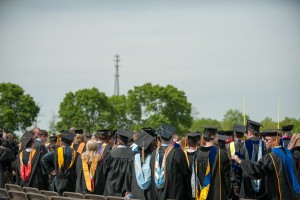
<div id="attachment_9071" style="width: 410px" class="wp-caption aligncenter"><img loading="lazy" decoding="async" aria-describedby="caption-attachment-9071" class="wp-image-9071" src="https://createquity.com/wp-content/uploads/2016/05/Undergrads2016-1-e1464144049314.jpg" alt="B.A. and Arts Double-Majors at Commencement 2016, UMD School of Theatre Dance and Performance Studies | Photo by Karen Kohn Bradley" width="400" height="328" srcset="https://createquity.com/wp-content/uploads/2016/05/Undergrads2016-1-e1464144049314.jpg 912w, https://createquity.com/wp-content/uploads/2016/05/Undergrads2016-1-e1464144049314-300x246.jpg 300w, https://createquity.com/wp-content/uploads/2016/05/Undergrads2016-1-e1464144049314-768x630.jpg 768w" sizes="auto, (max-width: 400px) 100vw, 400px" /><p id="caption-attachment-9071" class="wp-caption-text">B.A. and Arts Double-Majors at Commencement 2016, UMD School of Theatre Dance and Performance Studies | Photo by Karen Kohn Bradley</p></div>
<p>For pro artists, the necessity or desirability of arts degrees may vary considerably by discipline. Although full-time symphony orchestra musicians are selected by audition, it is <a href="http://www.concertgoersguide.org/backstage/path.php">hard to find one these days without a degree in music</a>. On the other hand, from the Oregon Ballet to Bally’s <i>Jubilee</i>, <a href="http://dpeaflcio.org/professionals/professionals-in-the-workplace/professional-performers/">dance</a> artists often delay or skip college because of the early <a href="http://www.theatlantic.com/entertainment/archive/2014/03/a-dancer-dies-twice-the-unique-sad-challenge-of-retiring-from-ballet/284187/">retirement</a> <a href="http://www.cpanda.org/data/a00191/changes.pdf">age</a> in most dance forms (<a href="http://dpeaflcio.org/professionals/professionals-in-the-workplace/professional-performers/">90.5% of working dancers and choreographers</a> are under age 40, compared to 39.6% of working musicians). Examples like these leave arts degree programs vulnerable to the charge that they are building up a profession (academia) that <a href="http://electricliterature.com/how-the-mfa-glut-is-a-disservice-to-students-teachers-and-writers/">isn&#8217;t necessarily serving artists</a>. Sarah Anne Austin <a href="https://www.danceusa.org/ejournal/2015/03/02/is-american-modern-dance-a-pyramid-scheme">questions</a>, “If opportunities in American modern dance are disappearing, and if being a tenured faculty member at a university is the only stable job available for dancers and choreographers, and having this job depends on being able to attract students… does this make American modern dance a pyramid scheme?”</p>
<p>&nbsp;</p>
<h3><b>One Option in a Long Line of Pricey Career Strategies?</b></h3>
<p>Such questions wouldn’t be so charged were it not for the very real concern that arts degrees perpetuate inequality in the sector. Professional artistry has a lengthy and complex gestation period that is slammed with socioeconomic obstacles. Factors that may make, or break, one’s professional success as an artist include personal <a href="http://www.createlondon.org/panic/survey/">networks</a>, the prestige of the teacher, portfolio materials, membership in a <a href="http://dpeaflcio.org/professionals/professionals-in-the-workplace/professional-performers/">union</a>/guild, affordable housing in a city with available arts jobs, and a myriad of other opportunities such as showcases, apprenticeships and <a href="http://snaap.indiana.edu/pdf/SNAAP15/SNAAP_Special_Report_2015.pdf">internships</a>.</p>
<p><a href="http://www.playbill.com/article/schools-of-the-stars-where-hamilton-cast-and-creators-went-to-college-com-355907" rel="attachment wp-att-9059"><img loading="lazy" decoding="async" class="aligncenter wp-image-9059" src="https://createquity.com/wp-content/uploads/2016/05/untitled-presentation-2-1024x870.png" alt="untitled-presentation (2)" width="492" height="418" srcset="https://createquity.com/wp-content/uploads/2016/05/untitled-presentation-2-1024x870.png 1024w, https://createquity.com/wp-content/uploads/2016/05/untitled-presentation-2-300x255.png 300w, https://createquity.com/wp-content/uploads/2016/05/untitled-presentation-2-768x653.png 768w, https://createquity.com/wp-content/uploads/2016/05/untitled-presentation-2.png 1200w" sizes="auto, (max-width: 492px) 100vw, 492px" /></a></p>
<p style="text-align: center;">Graphic by Shawn Lent for Createquity. Source: <a href="http://www.playbill.com/article/schools-of-the-stars-where-hamilton-cast-and-creators-went-to-college-com-355907">Playbill</a></p>
<p>Like aspiring athletes, emerging professional artists benefit from<a href="http://barryoreck.com/articles_papers/ArtisticTalentDevelopment.pdf"> school and community members</a> who identify and develop their interest, regular and rigorous private lessons, and pre-professional training. These present quite the financial hurdle for families: a recent calculation estimates that it takes <a href="http://fivethirtyeight.com/features/high-price-of-ballet-diversity-misty-copeland/">$100,000 to raise a professional ballerina</a>. Against this backdrop, the cost of college may only exacerbate what is already a yawning opportunity gap.</p>
<p>&nbsp;</p>
<h3><b>The Greatest Risk or the Great Arts Equalizer?</b></h3>
<p>We may not know definitively whether arts degrees provide added value to aspiring artists, but we do know that they pose quite a bit of risk, particularly for artists coming from low socioeconomic status (SES). Although artists with bachelor’s degrees in any major <a href="http://goo.gl/N2AYyx">earn more</a> than artists who went pro after high school, new BFA holders quickly face the reality that artists experience <a href="http://faos.ku.dk/pdf/undervisning_og_arrangementer/2010/ARTISTS__CAREERS_191010.pdf">lower returns</a> to formal education than they would in other professions. Anywhere from 10-20% of artists with bachelor’s degrees <a href="http://snaap.indiana.edu/snaapshot/#debt">report a “major impact” on their career decisions</a> due to debt from higher education; this <a href="http://www.wsj.com/news/interactive/BORROW021620130216?ref=SB10001424127887324432004578306610055834952">debt load</a> comes on top of a heavy <a href="http://www.jstor.org/stable/pdf/223516.pdf?seq=1#page_scan_tab_contents">earnings penalty</a> across the board for artists (<a href="http://faos.ku.dk/pdf/undervisning_og_arrangementer/2010/ARTISTS__CAREERS_191010.pdf">8.4 percent lower</a> than the rest of the labor market, according to 2000 Census data).</p>
<p><img loading="lazy" decoding="async" class="aligncenter wp-image-9081" src="https://createquity.com/wp-content/uploads/2016/05/untitled-presentation-3-1-1024x870.png" alt="untitled-presentation (3)" width="407" height="346" srcset="https://createquity.com/wp-content/uploads/2016/05/untitled-presentation-3-1-1024x870.png 1024w, https://createquity.com/wp-content/uploads/2016/05/untitled-presentation-3-1-300x255.png 300w, https://createquity.com/wp-content/uploads/2016/05/untitled-presentation-3-1-768x653.png 768w, https://createquity.com/wp-content/uploads/2016/05/untitled-presentation-3-1.png 1200w" sizes="auto, (max-width: 407px) 100vw, 407px" /></p>
<p style="text-align: center;">Graphic by Shawn Lent for Createquity. Source: <a href="https://nces.ed.gov/ipeds/datacenter/">U.S. Department of Education IPEDS Survey</a></p>
<p>Particularly on a discipline-specific basis, the conditions leading up to the decision to pursue professional artistry may represent <a href="https://createquity.com/issue/disparities/">disparities of access</a>. If it were the case that high school graduates who aspired to artistic careers couldn’t pursue their dreams because of the risk aversion associated with low SES, that would be a major failing of a <a href="https://createquity.com/about/a-healthy-arts-ecosystem/">healthy arts ecosystem</a>.</p>
<p style="text-align: left;">Given that, it’s probably a blessing in disguise that you don’t need an arts degree to become an artist. In fact, the preponderance of upper-middle-class students in programs offering those degrees might well indicate that poorer, emerging artists are making informed decisions that are in their best interests. Everyone’s situation is different, and statistics can only tell us so much about an individual case. But if you’re worried that an expensive four-year degree is your only way to the top of the arts heap, you can take heart in the knowledge that many, many creators and performers have made it there without one.</p>
<p style="text-align: left;"><strong><em>In the <a href="https://createquity.com/2016/08/createquity-podcast-series-2-the-cost-of-being-creative/" target="_blank">latest Createquity podcast series</a>, Createquity and Fractured Atlas team members illuminate the major factors that contribute to artists (or prevent artists from) establishing successful careers. We also focus on some of the tools Fractured Atlas has developed to support artists, with the larger goal of helping create a more navigable and equitable ecosystem for professional artists. </em></strong></p>
<p style="text-align: left;"><em>Cover image: “<a class="external" href="https://www.flickr.com/photos/kcadams/sets/72157653025897185/" target="_blank">Hiram College Commencement 2015</a>,” courtesy of Kasey-Samuel Adams via Flickr Creative Commons license. </em></p>
]]></content:encoded>
			<wfw:commentRss>https://createquity.com/2016/05/the-bfas-dance-with-inequality/feed/</wfw:commentRss>
		<slash:comments>12</slash:comments>
		</item>
		<item>
		<title>Who Will Be the Next Arts Revolutionary?</title>
		<link>https://createquity.com/2016/03/who-will-be-the-next-arts-revolutionary/</link>
		<comments>https://createquity.com/2016/03/who-will-be-the-next-arts-revolutionary/#comments</comments>
		<pubDate>Mon, 07 Mar 2016 16:00:03 +0000</pubDate>
		<dc:creator><![CDATA[Shawn Lent, Katie Ingersoll, Michael Feldman and Talia Gibas]]></dc:creator>
				<category><![CDATA[Features]]></category>
		<category><![CDATA[501(c)(3)]]></category>
		<category><![CDATA[capacity to create change]]></category>
		<category><![CDATA[cultural equity]]></category>
		<category><![CDATA[diversity]]></category>
		<category><![CDATA[Ford Foundation]]></category>
		<category><![CDATA[history of the arts ecosystem]]></category>
		<category><![CDATA[JFK]]></category>
		<category><![CDATA[McNeil Lowry]]></category>
		<category><![CDATA[Nancy Hanks]]></category>
		<category><![CDATA[NEA]]></category>
		<category><![CDATA[nonprofit sector]]></category>
		<category><![CDATA[Rockefeller Foundation]]></category>
		<category><![CDATA[rural arts]]></category>
		<category><![CDATA[Twentieth Century Fund]]></category>

		<guid isPermaLink="false">https://createquity.com/?p=8767</guid>
		<description><![CDATA[The story of how the nonprofit arts sector got started offers would-be changemakers some clues.]]></description>
				<content:encoded><![CDATA[<p>Take a listen to <a href="http://www.giarts.org/article/please-dont-start-theater-company">Voice 1</a>:</p>
<blockquote><p>In the past fifteen years, the number of nonprofit theater companies in the United States has doubled while audiences and funding have shrunk. Neither the field nor the next generation of artists is served by this unexamined multiplication&#8230;There has been tremendous collective buy-in to what has become a fossilized model.</p>
<p style="text-align: right;">—<em>Rebecca No</em><i>vick, theater director and arts consultant</i></p>
</blockquote>
<p>Then hear out <a href="http://nonprofitwithballs.com/2014/06/the-game-of-nonprofit-and-how-it-leaves-some-communities-behind/">Voice 2</a>:</p>
<blockquote><p>We communities of color are still trying to understand the mainstream nonprofit culture, with all its unwritten rules and regulations. We are trying to be better nonprofit players. We have to, because the game is not going to change any time soon, and those communities who don’t know the rules or who don’t practice enough are left behind… We have no choice.</p>
<p style="text-align: right;">—<em>Vu</em><i> Le, executive director of Rainier Valley Corps</i></p>
</blockquote>
<p>Stop and reflect on <a href="http://www.vanderbilt.edu/curbcenter/files/Chronicle-America-Needs-a-New-System1.pdf">Voice 3</a>:</p>
<blockquote><p>I&#8217;ve always been a bit uncomfortable with our sector&#8217;s be-all-and-end-all focus on the needs of the nonprofit arts… The sector has grown bigger without getting richer.</p>
<p style="text-align: right;"><i>—Bill Ivey, former chairman of the National Endowment for the Arts</i></p>
</blockquote>
<p>See if you agree with <a href="http://theabundantartist.com/go-your-own-way-fiscal-sponsorship-and-for-profit-arts/">Voice 4</a>:</p>
<blockquote><p>Funding organizations really do roll their eyes these days, when yet another nonprofit, pops up with its hands out. Reality: no one is gonna pay your tab.</p>
<p style="text-align: right;">—<em>Misha Pento</em><i>n, opera singer, theater artist, and artistic director of Divergence Vocal Theater </i></p>
</blockquote>
<p>Opinions about the nonprofit arts model—the fundamental legal and business structure in which arts nonprofits in the United States work—are as numerous and varied as 501(c)(3)s themselves. But one thing all of these quotes take for granted is the existence of the model itself. While that system may seem “fossilized” to some, the truth is that most arts nonprofits today are younger than most of our parents. The boom of arts nonprofits has been a relatively recent phenomenon, and it came about thanks in large part to a handful of individuals who intentionally put it into motion.</p>
<div id="attachment_8783" style="width: 603px" class="wp-caption aligncenter"><a href="https://createquity.com/2016/03/notes-to-who-will-be-the-next-arts-revolutionary"><img loading="lazy" decoding="async" aria-describedby="caption-attachment-8783" class="wp-image-8783" src="https://createquity.com/wp-content/uploads/2016/03/untitled-presentation-8-1024x870.png" alt="Infographic 1" width="593" height="504" srcset="https://createquity.com/wp-content/uploads/2016/03/untitled-presentation-8-1024x870.png 1024w, https://createquity.com/wp-content/uploads/2016/03/untitled-presentation-8-300x255.png 300w, https://createquity.com/wp-content/uploads/2016/03/untitled-presentation-8-768x653.png 768w, https://createquity.com/wp-content/uploads/2016/03/untitled-presentation-8.png 1200w" sizes="auto, (max-width: 593px) 100vw, 593px" /></a><p id="caption-attachment-8783" class="wp-caption-text">Graphic by Shawn Lent and Katherine Ingersoll for Createquity. See <a href="https://createquity.com/2016/03/notes-to-who-will-be-the-next-arts-revolutionary">endnotes</a> for additional detail on sourcing.</p></div>
<p>The story of the nonprofit model is <a href="https://www.independentsector.org/scope_of_the_sector">part of the broader heritage of nonprofits</a>, and follows a similar trajectory. A combination of intentional interventions and societal factors led to a massive expansion of the nonprofit sector in the United States in the middle of the 20th century, both in terms of size and portion of overall economic activity. Nonprofit expenses and assets actually <a href="http://www.urban.org/publications/901011.html">outpaced the economy</a> between 1994 and 2004 primarily thanks to the growth of hospitals, health organizations and private colleges. In 2012, there was <a href="http://www.urban.org/features/nonprofit-almanac-and-almanac-briefs">1 nonprofit for every 175 Americans</a>.</p>
<p>Despite such a boom, life inside the current arts ecosystem is not all it could be. Createquity’s mission is to identify the most important issues in the arts and what we can do about them, but a crucial barrier to executing on that premise is the sector’s limited <a href="https://createquity.com/issue/capacity/">capacity to create change</a>. While the 501(c)(3) arts model offers infrastructure that, in theory, combines artistic aspiration with public accountability, the decentralization and limited scope of government policy make large-scale, systemic change in the sector difficult to accomplish. Yet Createquity’s long-range goal is to do exactly that, or at the very least to catalyze it.</p>
<blockquote><p>One of the things that I pray for is that people with power will get good sense, and that people with good sense will get power&#8230;</p>
<p style="text-align: right;">—<i>Dixie Carter as <a href="http://www.imdb.com/title/tt0558661/">Julia Sugarbaker</a></i></p>
</blockquote>
<p>To accurately predict how change can happen in the arts ecosystem, it would help to understand how change has already taken place in our arts 501(c)(3) genealogy. Specifically, we want to know whether individuals or organizations can truly and intentionally marshal change, or if a cloudy mix of circumstances is responsible for where we are today. Has transformation in the arts sector historically been calculated and choreographed, or organic and inadvertent?</p>
<p>It turns out that a narrow time period starting in the mid-1950s and ending in the late 1970s presents clear examples of deliberate and broad action, precipitating one of the most extensive changes in the arts ecosystem: the spread and embrace of the nonprofit model as a mechanism for cultivating and promoting the arts and culture within the United States.</p>
<p>But first, some time travel is in order.</p>
<p style="text-align: center;"><a href="https://createquity.com/2016/03/notes-to-who-will-be-the-next-arts-revolutionary"><img loading="lazy" decoding="async" class="aligncenter wp-image-8801" src="https://createquity.com/wp-content/uploads/2016/03/output_CKo3Qj.gif" alt="Time Travel GIF" width="382" height="242" /></a></p>
<p>&nbsp;</p>
<h1 style="text-align: left;"><b>THE ARTS ECOSYSTEM’S EARLY DAYS</b></h1>
<p>The modern tax code, including the arts 501(c)(3) status we know today, was <a href="https://www.irs.gov/pub/irs-soi/tehistory.pdf">established in 1954</a>, but its roots stretch back much farther. Several of our nation’s first theaters and museums were built before the American Revolution, but voluntary associations in this colonial period (as well as in the freshly independent years following the war) were limited by the strong role of the church and emboldened by the lack of federal authority over them. The landmark 1819 Supreme Court decision of <a href="https://pantherfile.uwm.edu/mordecai/www/Dartmouth-longversion.pdf">Trustees of Dartmouth College vs. Woodward</a> further constrained the government’s power to intervene in private charitable organizations and set protection for incorporated endowments, including the few for arts institutions.</p>
<p style="text-align: center;"><img loading="lazy" decoding="async" class="aligncenter wp-image-8813" src="https://createquity.com/wp-content/uploads/2016/03/1.png" alt="Timeline graphic by Shawn Lent" width="636" height="353" srcset="https://createquity.com/wp-content/uploads/2016/03/1.png 810w, https://createquity.com/wp-content/uploads/2016/03/1-300x167.png 300w, https://createquity.com/wp-content/uploads/2016/03/1-768x427.png 768w" sizes="auto, (max-width: 636px) 100vw, 636px" /></p>
<p>From the <a href="http://www.metmuseum.org/about-the-museum/history-of-the-museum/main-building">Met</a> to the <a href="http://chicagotonight.wttw.com/2012/01/30/hull-house-art">Hull House</a>, arts participation in 19th century America was shaped by class division. Urban wealthy elites, their formal governing sway slipping away in a democratic society, <a href="https://books.google.com/books?hl=en&amp;lr=&amp;id=7n8dPi2ew9YC&amp;oi=fnd&amp;pg=PA32&amp;dq=%22nonprofit+organizations%22+infrastructure+history&amp;ots=1AlPoomYZM&amp;sig=sD_W1aPNVRI5eAwsU5nRASPF7N8#v=onepage&amp;q=%22nonprofit%20organizations%22%20infrastructure%20history&amp;f=false">established private organizations</a> to advance the greater good—and to preserve their class status. In the wake of civil war and the <a href="http://www.loc.gov/teachers/classroommaterials/presentationsandactivities/presentations/timeline/riseind/immgnts/">arrival of nearly 12 million immigrants</a>, Americans formed mutual aid societies and unions, but also private schools, libraries, social clubs, and a scattering of non-commercial museums and symphony orchestras.</p>
<p>Donations from wealthy individuals were the most important source of support, and policymakers in the late 1800s introduced the country’s <a href="https://www.irs.gov/pub/irs-soi/tehistory.pdf">first statutory references and implementation of tax exemption</a> for charitable organizations. In 1889, a certain Mr. Andrew Carnegie published “<a href="http://historymatters.gmu.edu/d/5767">Wealth</a>,” an essay pressing other tycoons to join him in donating considerable percentages of their fortunes for the good of society, including the arts and humanities. Years later, historians would credit Carnegie with conceptualizing what is now the modern philanthropic foundation.</p>
<div id="attachment_8773" style="width: 471px" class="wp-caption aligncenter"><a href="https://flic.kr/p/9Te3US"><img loading="lazy" decoding="async" aria-describedby="caption-attachment-8773" class="wp-image-8773 " src="https://createquity.com/wp-content/uploads/2016/03/5830541690_24f5c928a7_b-1024x768.jpg" alt="&quot;The Immigrants,&quot; by Luis Sanguino in Battery Park" width="461" height="345" srcset="https://createquity.com/wp-content/uploads/2016/03/5830541690_24f5c928a7_b.jpg 1024w, https://createquity.com/wp-content/uploads/2016/03/5830541690_24f5c928a7_b-300x225.jpg 300w, https://createquity.com/wp-content/uploads/2016/03/5830541690_24f5c928a7_b-768x576.jpg 768w" sizes="auto, (max-width: 461px) 100vw, 461px" /></a><p id="caption-attachment-8773" class="wp-caption-text">&#8220;The Immigrants,&#8221; by Luis Sanguino in Battery Park &#8211; photo by flickr user k31thw</p></div>
<p>Even so, through the rip-roaring early part of the 20th century, the dominant vehicle for performing arts enterprises, from jazz clubs to theater ensembles, was the <a href="http://www.giarts.org/article/leverage-lost">commercial sole proprietorship</a>. As the socioeconomic gap became a socioeconomic crater, philanthropic support for arts nonprofits remained limited and highly <a href="http://www.philanthropyroundtable.org/topic/excellence_in_philanthropy/the_birth_of_big_time_fundraising">localized</a>. Coming out of the Great Depression and WWII, national foundations like Carnegie’s were primarily setting their sights on educational goals.</p>
<p>All the while, <a href="https://createquity.com/2016/03/notes-to-who-will-be-the-next-arts-revolutionary#Note1">countless early arts pioneers, renegades, and boat rockers</a> had the ambition to innovate on the local level, and many eventually saw the fruits of their efforts spread to varying degrees. But it wasn’t until the middle of the 20th century that the stage was set for sweeping transformation for the arts at the national level.</p>
<p>&nbsp;</p>
<h1 style="text-align: left;"><b>A MAN ON A MISSION<br />
</b></h1>
<blockquote>
<p style="text-align: left;">There are people who more than others constantly see themselves between past and future, &#8230;both in their own lives and in the history of mankind. And I’m one of those persons.</p>
</blockquote>
<p style="text-align: right;"><a href="http://www.americansforthearts.org/by-program/reports-and-data/legislation-policy/naappd/the-awkward-embrace-the-creative-artist-and-the-institution-in-america">—W. McNeil Lowry</a></p>
<p>In the early 1950s, an executive named William McPeak participated in a study group for the <a href="http://www.fordfoundation.org/about-us/history">Ford Foundation</a>, which was exploring potential new structures and priorities as it prepared to become the largest foundation in the world. McPeak was pushing Ford to include the humanities in its vision for the future. One of his confidants during that struggle was W. McNeil “Mac” Lowry, a civilian journalist with <a href="http://www.nytimes.com/1993/06/07/obituaries/w-mcneil-lowry-is-dead-patron-of-the-arts-was-80.html">the Washington bureau of Cox Newspapers</a> who had been McPeak&#8217;s colleague at the <a href="https://en.wikipedia.org/wiki/United_States_Office_of_War_Information#Controversies_at_home">Office of Wartime Information</a>. Ford ultimately decided against funding the humanities when it expanded its scope from serving Detroit to focusing on social justice nationally and internationally, moving its office to New York City, but McPeak was hired as Ford’s Associate Director in 1953 and he <a href="http://archives.library.illinois.edu/ead/ua/2620096/2620096b.html">brought Lowry on board</a> as his assistant.</p>
<p>Two years into his tenure, Lowry was promoted to Program Director for Education and started suggesting ad hoc humanities grants under this education arm. They were small and few, and they were accepted. He also began writing policy papers and advocating internally for the creation of a large, full-fledged arts and humanities funding arm. This proposal was bold and unprecedented for any foundation at the time. With persistence and McPeak’s partnership, a mere four years after joining the foundation, Lowry was named director of its newly minted Division of Humanities and the Arts.</p>
<p>Lowry aimed to leverage Ford’s dollars and influence toward a <a href="http://www.newyorker.com/magazine/2016/01/04/what-money-can-buy-profiles-larissa-macfarquhar">grand vision of a robust arts field </a>across the United States, but he started with a more tangible and comprehensible project: an inventory of the field conducted through interviews with artists and arts stakeholders, which would subsequently inform the decision on the part of <a href="https://www.fordfoundation.org/library/annual-reports/1956-annual-report/">Ford’s trustees </a>whether to make the program permanent.</p>
<div id="attachment_8772" style="width: 516px" class="wp-caption aligncenter"><a href="https://flic.kr/p/ahbzfL"><img loading="lazy" decoding="async" aria-describedby="caption-attachment-8772" class="wp-image-8772" src="https://createquity.com/wp-content/uploads/2016/03/6090337836_d0921ca137_b-1-1024x768.jpg" alt="ripple effect" width="506" height="380" srcset="https://createquity.com/wp-content/uploads/2016/03/6090337836_d0921ca137_b-1.jpg 1024w, https://createquity.com/wp-content/uploads/2016/03/6090337836_d0921ca137_b-1-300x225.jpg 300w, https://createquity.com/wp-content/uploads/2016/03/6090337836_d0921ca137_b-1-768x576.jpg 768w" sizes="auto, (max-width: 506px) 100vw, 506px" /></a><p id="caption-attachment-8772" class="wp-caption-text">ripple effect &#8211; photo by flickr user Judy van der Velden</p></div>
<p>Lowry knew that his audience didn’t initially take his project very seriously. But as his assistant Marcia Thompson put it, it quickly became clear that the trustees “<a href="http://www.americansforthearts.org/by-program/reports-and-data/legislation-policy/naappd/the-awkward-embrace-the-creative-artist-and-the-institution-in-america">were not only entertained but were enormously interested in the field.</a>” Lowry <a href="http://www.americansforthearts.org/by-program/reports-and-data/legislation-policy/naappd/the-awkward-embrace-the-creative-artist-and-the-institution-in-america">later said of his thinking</a>,</p>
<blockquote>
<p style="text-align: left;">It was not any secret to me what the little start of that program in 1957 might mean on a national basis&#8230; It’s just, you couldn’t divulge it because it was still dream and plan… <b>This work is… a little bit like casting a stone in a puddle, but precisely which stone and precisely which puddle and for precisely which effect [is] the real creative part of it. </b></p>
</blockquote>
<p>He and Thompson began by giving themselves the task of creating a directory with the names and contact information of every art critic and artist they could find around the country. Long before digital spreadsheets or the Internet, this was a hefty self-assignment. A former journalist with <a href="http://www.trumanlibrary.org/oralhist/lowrywm.htm">a history of telling it like it is</a>, Lowry was willing to question loyalties and cliques. For example, he worked to extend professional arts opportunities outside major metropolitan areas even though several Ford trustees with connections to prominent New York institutions pushed back. He, along with associate director <a href="http://www.nytimes.com/1991/05/03/obituaries/edward-f-d-arms-87-executive-and-teacher.html">Edward F. D’Arms</a>, <a href="http://howlround.com/what-history-can-teach-us-about-arts-philanthropy-in-the-age-of-obama">traveled the country to speak with artists and stakeholders at over 175 arts companies</a>. Lowry’s was a personal approach which gave him strong buy-in and trust from people who were actually engaged in arts work; he preferred <a href="http://www.philanthropyroundtable.org/almanac/the_arts_and_culture/1953_cultural_kingmaker_at_the_ford_foundation">direct correspondence</a> with prospective grantees, including the likes of James Baldwin and Tom Stoppard. Lowry synthesized this mountain of data with more formal knowledge from economics and policy to begin to design the functions of Ford’s arts program.</p>
<div id="attachment_8771" style="width: 566px" class="wp-caption aligncenter"><a href="https://flic.kr/p/A6xyn3"><img loading="lazy" decoding="async" aria-describedby="caption-attachment-8771" class="wp-image-8771" src="https://createquity.com/wp-content/uploads/2016/03/22378869932_209033278b_b-1024x655.jpg" alt="Columbus, Ohio's State Capitol from the Air (1957)" width="556" height="356" srcset="https://createquity.com/wp-content/uploads/2016/03/22378869932_209033278b_b.jpg 1024w, https://createquity.com/wp-content/uploads/2016/03/22378869932_209033278b_b-300x192.jpg 300w, https://createquity.com/wp-content/uploads/2016/03/22378869932_209033278b_b-768x491.jpg 768w" sizes="auto, (max-width: 556px) 100vw, 556px" /></a><p id="caption-attachment-8771" class="wp-caption-text">Columbus, Ohio&#8217;s State Capitol from the Air (1957) &#8211; photo by flickr user Sent from the Past</p></div>
<p>Choosing to start with theater as his first arts discipline, Lowry used his new directory to send out a wide call for proposals, looking for groups (many of which were either sole proprietorships or amateur projects at the time) that seemed ready for the next step in professionalization. The focus was on smaller organizations outside the big cities because he did not want to see “<a href="http://www.americansforthearts.org/by-program/reports-and-data/legislation-policy/naappd/the-awkward-embrace-the-creative-artist-and-the-institution-in-america">money that could go to artists and artistic directors or to their outlets put in bricks and mortar.</a>” With an <a href="http://www.americantheatre.org/2015/06/16/going-national-how-americas-regional-theatre-movement-changed-the-game/">investment of $9 million</a> in 1961, the Ford Foundation had gathered steam for what would become the <a href="http://www.americantheatre.org/2015/06/16/going-national-how-americas-regional-theatre-movement-changed-the-game/">regional theater movement</a>. After seven years of commercial operation, <a href="https://www.tcg.org/publications/at/2001/zelda.cfm">Zelda Fichandler</a> transformed DC’s Arena Stage into one of the country’s first nonprofit theaters, <a href="http://blog.americansforthearts.org/2011/05/16/l3c-cha-cha-cha">primarily to receive a grant from the Ford Foundation</a>.</p>
<p>One of Lowry’s primary aims was to increase the amount of professional performing arts activity in the country, but he wanted to be inclusive whenever possible. He had intended to fund a black theater when he launched the program in 1957 but was unable to locate a promising black artistic director able to get a new theater up and running. A couple years after Martin Luther King Jr. inspired the country with his dream of integration, a playwright named Douglas Turner Ward wrote an editorial in the New York Times about the need for a black theater, supporting disenfranchised artists, managers, writers, and designers. Lowry read the article and contacted Ward immediately. Shortly after, with a Ford grant of $434,000 ($3.3 million in 2016 dollars), Ward, producer/actor Robert Hooks and theater manager Gerald Krone would establish the <a href="http://necinc.org/history/">Negro Ensemble Theatre Company</a> in 1965.</p>
<p>Lowry got artists out of their comfort zones and towards professionalization, and was well aware of the consequences of him doing so. <a href="http://www.americansforthearts.org/by-program/reports-and-data/legislation-policy/naappd/the-awkward-embrace-the-creative-artist-and-the-institution-in-america">As he describes it</a>,</p>
<blockquote><p>[artistic producers] had to think about ‘where does this move us to the next phase?’&#8230;They took on costly activities that they had ignored before…. So they were stretched. And some of them were even shrewd enough to say in advance of a grant, ‘You’re going to stretch me, aren’t you?’ I’d say, ‘Yes, I’m sorry, that’s an inevitable consequence of this.’”</p></blockquote>
<p>Under his direction, arts grants now required matching dollars for the first time and arts grantees were pushed to improve their marketing practices. For example, he directly supported <a href="http://www.bruceduffie.com/dannynewman.html">Danny Newman</a>, the press agent at Chicago Lyric Opera, to evangelize the subscription model to performing arts organizations across the country.</p>
<p>Lowry’s legacy also stretched entire segments of the performing arts. During his tenure, Ford <a href="http://howlround.com/what-history-can-teach-us-about-arts-philanthropy-in-the-age-of-obama#sthash.HGqXojMB.dpu">invested $19.5 million to help build 17 resident professional theaters between 1962 and 1976,</a> and was the first American foundation to fund dance on a large scale (<a href="http://www.americansforthearts.org/by-program/reports-and-data/legislation-policy/naappd/the-awkward-embrace-the-creative-artist-and-the-institution-in-america">$22.5 million from 1957-1973</a>). Ford&#8217;s largest arts investment over this time was <a href="http://www.americansforthearts.org/by-program/reports-and-data/legislation-policy/naappd/the-awkward-embrace-the-creative-artist-and-the-institution-in-america">the Symphony Orchestra Program ($80.2 million)</a>. Lowry retired from his position as Vice President at Ford in 1974, and passed away in 1993.</p>
<p>Mac Lowry could easily be labeled one of the nonprofit arts sector’s most significant figures of all time. No exaggeration. Lincoln Kirstein, co-founder of the New York City Ballet, <a href="http://www.nytimes.com/1993/06/07/obituaries/w-mcneil-lowry-is-dead-patron-of-the-arts-was-80.html">described Lowry</a> as “the single most influential patron of the performing arts that the American democratic system has produced.” By changing the financial incentives for artists, he directly helped to create an entire field of professional, nonprofit performing arts institutions. Thanks to Lowry, Ford became not only the first foundation to fund arts institutions on a large scale (making <a href="http://www.americansforthearts.org/by-program/reports-and-data/legislation-policy/naappd/the-awkward-embrace-the-creative-artist-and-the-institution-in-america">$249.8 million worth of arts grants 1957-1973</a>,<a href="http://www.americansforthearts.org/by-program/reports-and-data/legislation-policy/naappd/the-awkward-embrace-the-creative-artist-and-the-institution-in-america"> or nearly $2 billion in today’s dollars</a>), but also the largest nongovernmental funder of the nonprofit performing arts.</p>
<p>In this position, the Ford Foundation was able to exert considerable influence on the sector. Bill Ivey notes that “<a href="http://www.vanderbilt.edu/curbcenter/files/Chronicle-America-Needs-a-New-System1.pdf">the &#8216;Ford model&#8217; remains the gold standard shaping intervention in America&#8217;s arts system.</a>” Decades later, Ford is 5th on a list of the <a href="http://www.giarts.org/sites/default/files/ArtsFundingStudy1999.pdf">top 25 arts funders</a>, which underscores how the number of foundations interested in the arts has grown over time, and the strength of Lowry’s legacy in philanthropy.</p>
<p>At the Ford Foundation, Lowry had been given wide latitude to try new things, with a significant amount of money. His success had always been boosted by internal support from McPeak, but in 1966 Ford welcomed one of its more liberal presidents, McGeorge Bundy, who came to Ford from the Johnson administration and his “Great Society” programs. Under Bundy’s leadership, Ford was an instigator of public-private philanthropy and Lowry was able to connect to the subsidy argument of federal support for the arts. <a href="https://books.google.com/books/about/The_Arts_and_Public_Policy_in_the_United.html?id=jVNQAAAAMAAJ">Lowry later reflected that</a> “a pervasive effect of the Ford program was the enlightenment that began to spread not only about the importance of nonprofit artistic enterprises, but more precisely their justification for subsidy.”</p>
<p>Lowry and his colleagues were able to ride a wave of public support and concern while acknowledging and working with, not against, broader political agendas. To Createquity, this insight seems critical to understanding why monumental change could take place when it did, and it raises the question of how such transformation could be possible in our current polarized political climate.</p>
<p style="text-align: center;"><img loading="lazy" decoding="async" class="aligncenter wp-image-8831 " src="https://createquity.com/wp-content/uploads/2016/03/1-1.png" alt="1" width="605" height="336" srcset="https://createquity.com/wp-content/uploads/2016/03/1-1.png 810w, https://createquity.com/wp-content/uploads/2016/03/1-1-300x167.png 300w, https://createquity.com/wp-content/uploads/2016/03/1-1-768x427.png 768w" sizes="auto, (max-width: 605px) 100vw, 605px" /></p>
<p>&nbsp;</p>
<h1 style="text-align: left;"><b>THREE ARTS PRESIDENTS AND A NANCY</b></h1>
<p>With standoffs with Vladimir Putin and strikes at orchestras, theaters and beyond dominating modern newsfeeds, it is difficult to imagine a contemporary POTUS declaring the arts as a diplomatic weapon against Russia or sending the Secretary of Labor to personally mediate a dispute between a major arts institution and its workers. Yet in the late 1950s and early 1960s, that is exactly what happened.</p>
<p>As Lowry’s influence at Ford evolved, so did the operative role of the federal government in the arts. President Eisenhower, a Republican, advocated in his 1955 State of the Union address for the establishment of a Federal Advisory Commission on the Arts. This was cultural <a href="http://www.vqronline.org/essay/cultural-cold-war-history">cold war</a>: as <a href="https://www.tcg.org/publications/at/2001/zelda.cfm">one artistic director put it</a>, “Eisenhower spoke of a lack of achievement in the cultural sphere: Who did we have to export in terms of ballet, opera and theatre companies? How could we compete with Russia, which had such a rich cultural spectrum of performing arts?”</p>
<div id="attachment_8770" style="width: 510px" class="wp-caption aligncenter"><a href="https://flic.kr/p/aw1e2h"><img loading="lazy" decoding="async" aria-describedby="caption-attachment-8770" class="wp-image-8770" src="https://createquity.com/wp-content/uploads/2016/03/6246749598_b628141af7_b-1-1024x692.jpg" alt="Bolshoi Ballet Theatre in Moscow" width="500" height="338" srcset="https://createquity.com/wp-content/uploads/2016/03/6246749598_b628141af7_b-1.jpg 1024w, https://createquity.com/wp-content/uploads/2016/03/6246749598_b628141af7_b-1-300x203.jpg 300w, https://createquity.com/wp-content/uploads/2016/03/6246749598_b628141af7_b-1-768x519.jpg 768w" sizes="auto, (max-width: 500px) 100vw, 500px" /></a><p id="caption-attachment-8770" class="wp-caption-text">Bolshoi Ballet Theatre in Moscow &#8211; photo by flickr user appaIoosa</p></div>
<p>Although Eisenhower was <a href="https://books.google.com/books?id=f0v5ZwQWEL8C&amp;lpg=PA280&amp;pg=PA21#v=onepage&amp;q&amp;f=false">all talk and little action on the arts</a> and no formal advisory body was created during his two terms, he did have one major accomplishment: the passing of the National Cultural Center Act of Congress in 1958, which would set the stage for the founding of a certain, prominent national performing arts center on the Potomac River thirteen years later.</p>
<p>Two years later, John F. Kennedy won the election with a party platform that included <a href="http://www.cato.org/pubs/pas/pa137.html">a brief mention</a> of &#8220;a federal advisory agency to assist in the evaluation, development, and expansion of cultural resources.” Although he didn’t have a cultural agenda, the Kennedy Administration would be the one to finally elevate cultural policy to a national priority.</p>
<p>During his first year as President, Kennedy had the White House taking direct action in the arts. When the American Federation of Musicians Local 802 led a strike against The Metropolitan Opera during his first year in office, Kennedy sent Secretary of Labor Arthur Goldberg to arbitrate the salary <a href="http://www.cato.org/pubs/pas/pa137.htm">dispute</a> that had halted the current production season. While serving as the mediator in his office, Goldberg suggested that government funds be used to help settle the Met’s $840,000 debt (that would be more than $6.6 million federal dollars today used to bail out a private arts institution); it’s a safe bet today’s Congress would not get behind that.</p>
<p>Possibly influenced by <a href="http://www.upenn.edu/pnc/ptkoch.html">Jacqueline Kennedy’s love for the arts</a>, President Kennedy expanded his public support, <a href="https://www.arts.gov/sites/default/files/nea-history-1965-2008.pdf">saying</a>, “The life of the arts, far from being an interruption, a distraction, in the life of a nation, is very close to the center of a nation’s purpose . . . and is a test of the quality of a nation’s civilization.” In contrast to Eisenhower’s cold war logic, Kennedy’s policy vision would position arts and culture as sources of national hope and solidarity, continuing to push toward both a national center and a federal agency for arts and culture.</p>
<p>President Kennedy was active in the arts right up until his shocking murder in Dallas. In 1963 alone, he emphasized the importance of <a href="http://www.jfklibrary.org/Research/Research-Aids/JFK-Speeches/Amherst-College_19631026.aspx">national recognition of the arts</a> in a speech at the dedication of the Robert Frost Library at Amherst College; established the <a href="http://www.presidency.ucsb.edu/ws/index.php?pid=9275&amp;st=advisory+council+on+the+arts&amp;st1=">Advisory Council on the Arts</a> (not appointed until after his death); and commissioned a <a href="http://catalog.hathitrust.org/Record/007904621">report</a> by August Heckscher, director of the Twentieth Century Fund and his special consultant for the arts, on the <a href="http://www.cato.org/pubs/pas/pa137.html">relationship between the arts and the Federal government</a>.</p>
<p>Together, these resources laid the foundation for the ultimate achievement in linking federal government to arts and culture, the signing of the <a href="https://www.arts.gov/sites/default/files/NEAChronWeb.pdf">National Endowment for the Arts</a> and National Endowment for the Humanities into law in 1965 by President Lyndon Baines Johnson. Johnson chose Roger Lacey Stevens, a Broadway <a href="http://www.nytimes.com/1998/02/04/arts/roger-l-stevens-real-estate-magnate-producer-and-fund-raiser-is-dead-at-87.html">producer</a> who had led the fundraising efforts for the National Cultural Center (later renamed <a href="http://www.kennedy-center.org/pages/about/history">The John F. Kennedy Center for the Performing Arts</a>), as the NEA’s first Chairman and Special Assistant on the Arts.</p>
<div id="attachment_8774" style="width: 506px" class="wp-caption aligncenter"><a href="https://flic.kr/p/BRgVwr"><img loading="lazy" decoding="async" aria-describedby="caption-attachment-8774" class="wp-image-8774 " src="https://createquity.com/wp-content/uploads/2016/03/23530101921_cd2a9a339f_k-1024x683.jpg" alt="NEH Chairman William Adams tours the Lyndon B. Johnson Presidential Library exhibits" width="496" height="331" srcset="https://createquity.com/wp-content/uploads/2016/03/23530101921_cd2a9a339f_k-1024x683.jpg 1024w, https://createquity.com/wp-content/uploads/2016/03/23530101921_cd2a9a339f_k-300x200.jpg 300w, https://createquity.com/wp-content/uploads/2016/03/23530101921_cd2a9a339f_k-768x512.jpg 768w, https://createquity.com/wp-content/uploads/2016/03/23530101921_cd2a9a339f_k.jpg 2048w" sizes="auto, (max-width: 496px) 100vw, 496px" /></a><p id="caption-attachment-8774" class="wp-caption-text">NEH Chairman William Adams tours the Lyndon B. Johnson Presidential Library exhibits &#8211; photo by the LBJ Foundation on flickr</p></div>
<p>Following Stevens’s brief inaugural tenure as NEA Chairman, <a href="https://www.arts.gov/sites/default/files/nea-history-1965-2008.pdf">Nancy Hanks</a> (not the mother of the 16th President of the United States, for whom she is descended and named), was selected to head the search for his successor. After <a href="http://biography.yourdictionary.com/nancy-hanks">several prominent figures had turned the position down</a>, Hanks herself was appointed by President Nixon in 1969; according to Stevens, &#8220;<a href="https://www.washingtonpost.com/archive/lifestyle/1983/01/10/nancy-hanks-gentle-persuasion/b6b3b39e-7505-404b-9732-75e29a2baee5/">they were looking for some women for jobs.</a>&#8221; She was a Southern Republican and a Duke University graduate who began her career as a <a href="http://biography.yourdictionary.com/nancy-hanks">DC receptionist</a> and later gained White House experience as assistant to Nelson A. Rockefeller and his arts programs. Afterward, while on staff at The Rockefeller Brothers Fund, Hanks published the influential report, <i>The Performing Arts: Problems &amp; Prospects</i> (1965). By the end of the 1960s, she had both been named <a href="https://books.google.com/books?id=EImTCwAAQBAJ&amp;lpg=PT128&amp;ots=4V0fnTppzb&amp;dq=nancy%20hanks%20nea&amp;pg=PT127#v=onepage&amp;q=nancy%20hanks%20nea&amp;f=false">president of the Associated Council on the Arts (ACA)</a> and diagnosed with cancer. She chose to remain unmarried and without children; she would later be deemed the <a href="http://biography.yourdictionary.com/nancy-hanks">mother of a million artists</a>.</p>
<p>Amidst the burgeoning feminist movement, Hanks took the reins of a then-nascent NEA with grander aims for the agency. In her first six weeks at the helm of the NEA, <a href="http://biography.yourdictionary.com/nancy-hanks#7JDbVG307utbjwsS.99">she personally spoke to 200 Congressmen to advocate for her proposal to double the budget</a> and to secure future appropriations for the nation’s bicentennial, which was more than six years ahead. Hanks was a sagacious power; her office became a lobbying machine.</p>
<p><a href="https://www.washingtonpost.com/archive/lifestyle/1983/01/10/nancy-hanks-gentle-persuasion/b6b3b39e-7505-404b-9732-75e29a2baee5/"><img loading="lazy" decoding="async" class="aligncenter wp-image-8793" src="https://createquity.com/wp-content/uploads/2016/03/output_zBQZaR-1.gif" alt="output_zBQZaR" width="444" height="372" /></a></p>
<p>&nbsp;</p>
<p>She battled her cancer quietly while strongarming Congress, protecting NEA political territory, and preempting controversies for the agency. In 1970, when the NEA budget faced the ax, Hanks and her assistant <a href="http://www.nytimes.com/1983/01/08/obituaries/nancy-hanks-dead-at-55-headed-national-arts-group.html">individually cornered over 100 Congressmen</a> and succeeded in swaying their votes. Julia Butler Hansen, a Democrat from Washington State and chairwoman of the House appropriations subcommittee during that term, said she needed to see <a href="https://www.washingtonpost.com/archive/lifestyle/1983/01/10/nancy-hanks-gentle-persuasion/b6b3b39e-7505-404b-9732-75e29a2baee5/">letters from constituents</a> to be convinced, so Hanks somehow got a form letter onto every theater seat in the country and, within a few weeks, had thousands of them into Hansen&#8217;s mailbox. When artists won prestigious prizes, Hanks would send out letters to the Representatives of their home states, reminding them that &#8220;<a href="http://www.nytimes.com/1983/01/08/obituaries/nancy-hanks-dead-at-55-headed-national-arts-group.html">good artists do not just happen.</a>&#8221;</p>
<p>Hanks put a large emphasis on grants to institutions, which <a href="https://news.google.com/newspapers?nid=1144&amp;dat=19770922&amp;id=a1kdAAAAIBAJ&amp;sjid=6FcEAAAAIBAJ&amp;pg=6889,2878716&amp;hl=en">helped to make arts funding a bipartisan issue</a> since many wealthy board members of symphonies and museums were Republicans like her. The concept of public subsidy for the arts was sold as a cure for the “cost disease” endemic to nonprofit arts organizations. Revenue and private donations alone could not support the sector, she believed; the income gap must be filled.</p>
<p>With an <i>art-for-all-Americans </i>ethos, Hanks supported a plentitude of smaller nonprofit arts organizations in newly funded areas such as crafts. Additionally, Hanks played an instrumental role in establishing the Arts Council of Americas to unite the <a href="http://www.americansforthearts.org/by-program/reports-and-data/legislation-policy/naappd/arts-america-1780%E2%80%932015">more than 50 community arts councils already in existence</a> and in expanding the National Assembly of State Arts Agencies in order to have a well-funded state council in every state and territory in the U.S. Much of the NEA’s funding was designated to run through these state councils.</p>
<p>Later in her tenure Hanks authorized the NEA Challenge Grants, which <a href="http://www.tandfonline.com/doi/abs/10.1080/09548963.2013.817645">demanded matching contributions</a> to leverage investment from the private sector. This was <a href="http://www.giarts.org/article/leverage-lost">a strategy similar to those of the Ford Foundation in the 1960s and the Johnson Administration&#8217;s War on Poverty.</a></p>
<p>Before Hanks, the NEA was more of a figurehead organization with a modest budget; by 1976, it was the <a href="https://books.google.com/books/about/Philanthropy_and_the_Nonprofit_Sector_in.html?id=195wkm6SoOsC&amp;source=kp_read&amp;printsec=frontcover&amp;source=kp_read_button#v=onepage&amp;q&amp;f=false">largest institutional funder of the arts in the country</a>. In brief, she was the <a href="https://books.google.com/books?id=EImTCwAAQBAJ&amp;lpg=PT128&amp;ots=4V0fnTppzb&amp;dq=nancy%20hanks%20nea&amp;pg=PT127#v=onepage&amp;q=nancy%20hanks%20nea&amp;f=false">savviest operator in the NEA’s history</a>. She served two terms as the NEA chair until her resignation in 1977, and she died of her cancer six years later at age 55. A mere three weeks after her passing, President Reagan (whose economic policies were threatening the existence of the NEA and NEH at the time) signed a law renaming NEA and NEH’s erstwhile home, the Old Post Office, in Washington, D.C. the Nancy Hanks Center.</p>
<p>&nbsp;</p>
<div id="attachment_8769" style="width: 495px" class="wp-caption aligncenter"><a href="https://flic.kr/p/o1nyNV"><img loading="lazy" decoding="async" aria-describedby="caption-attachment-8769" class="wp-image-8769" src="https://createquity.com/wp-content/uploads/2016/03/14444056617_99d5fc5865_o.jpg" alt="Washington State Library, Go to Theatre Week, 1922" width="485" height="273" srcset="https://createquity.com/wp-content/uploads/2016/03/14444056617_99d5fc5865_o.jpg 910w, https://createquity.com/wp-content/uploads/2016/03/14444056617_99d5fc5865_o-300x169.jpg 300w, https://createquity.com/wp-content/uploads/2016/03/14444056617_99d5fc5865_o-768x432.jpg 768w" sizes="auto, (max-width: 485px) 100vw, 485px" /></a><p id="caption-attachment-8769" class="wp-caption-text">Go to Theatre Week, 1922 – photo by Washington State Library</p></div>
<h1 style="text-align: left;"><b>HOW LOWRY AND HANKS CHANGED THE ARTS NONPROFIT SECTOR FOREVER</b></h1>
<p>Neither Lowry nor Hanks saw themselves as artists (Hanks said her only art form was “<a href="https://books.google.com/books?id=EImTCwAAQBAJ&amp;lpg=PT128&amp;ots=4V0fnTppzb&amp;dq=nancy%20hanks%20nea&amp;pg=PT128#v=onepage&amp;q=nancy%20hanks%20nea&amp;f=false">needlepoint typewriter covers</a>”; others said that it clearly <a href="http://www.nytimes.com/1983/01/08/obituaries/nancy-hanks-dead-at-55-headed-national-arts-group.html">persuasion</a>), yet both were passionate in building towards a new arts vision for America, supporting and connecting artists nationwide. They were willing to defy the expectations and design of their jobs in order to create financial and structural support for artists. Both traveled the country for the cause; Lowry to discover promising artistic directors, and Hanks to advocate on their behalf.</p>
<p>Their combined legacy was to establish the current shape of the nonprofit arts sector and its mechanisms of funding. Importantly, both the Ford Foundation and the federal government brought vast new resources to the arts funding table, and directed those resources almost exclusively to nonprofit arts organizations. In doing so, not only did Lowry and Hanks catalyze the arts 501(c)(3) boom, they created the common practice of matching grants, the growth and coordination of local arts agencies, the use of grant panels, the rise of grantwriter-as-paid-employee in arts institution, and more. The influence of each can be seen in the geographic spread of infrastructure to support the arts across the country &#8212; regional theaters, dance companies, and symphony orchestras in Lowry’s case, and arts councils in Hanks’s.</p>
<p>They engineered the initial professionalization of the field. <a href="http://www.giarts.org/article/neolithic-prehistory-classical-era">Publications and conferences</a>, like those of the <a href="http://www.tcg.org/about/index.cfm">Theatre Communications Group</a> which Lowry first convened, declared and disseminated best practices. The effect of these deliberate acts was characteristic of the organizational ecology concept of “<a href="http://jom.sagepub.com/content/early/2014/03/24/0149206314527129">legitimation</a>”: as a particular type of organization becomes more accepted, it is established more and more frequently. By the mid-1970s, the nonprofit was set as the expected and dominant legal structure for new arts organizations.</p>
<p>We approached this research wanting to learn <i>how </i>change happens; we didn&#8217;t intend to dwell on whether the change has been good or bad. That said, there are several aspects of the arts ecosystem in America today that seem to have been shaped by from the transformation fostered by Lowry, Hanks, Kennedy, and others in the middle of the 20th century.</p>
<p>&nbsp;</p>
<h3><b><b>There is more, more, more</b></b></h3>
<p>The timing of the boom differed by discipline, but all disciplines saw sustained growth when they began to embrace the nonprofit structure. Overall, despite <a href="http://foundationcenter.org/gainknowledge/research/pdf/artsfunding_2014.pdf">government funding cuts</a>, <a href="http://www.upenn.edu/pnc/ptkoch.html">Reaganomics and the culture wars</a>, the <a href="http://foundationcenter.org/gainknowledge/research/pdf/artsfunding2009.pdf">leveling of private funding</a>, and periodic <a href="http://www.urban.org/sites/default/files/alfresco/publication-pdfs/2000497-The-Nonprofit-Sector-in-Brief-2015-Public-Charities-Giving-and-Volunteering.pdf">recessions</a> since the 1980-90s, the number of arts nonprofit organizations has shown continued, though slowing, growth.</p>
<p style="text-align: center;"><a href="https://createquity.com/2016/03/notes-to-who-will-be-the-next-arts-revolutionary"><img loading="lazy" decoding="async" class="aligncenter wp-image-8784" src="https://createquity.com/wp-content/uploads/2016/03/untitled-presentation-9-1024x870.png" alt="untitled-presentation (9)" width="589" height="501" srcset="https://createquity.com/wp-content/uploads/2016/03/untitled-presentation-9-1024x870.png 1024w, https://createquity.com/wp-content/uploads/2016/03/untitled-presentation-9-300x255.png 300w, https://createquity.com/wp-content/uploads/2016/03/untitled-presentation-9-768x653.png 768w, https://createquity.com/wp-content/uploads/2016/03/untitled-presentation-9.png 1200w" sizes="auto, (max-width: 589px) 100vw, 589px" /></a></p>
<p>What does that growth tell us about the number of people being served by these organizations, or about the amount of art available in general? We know that as the nonprofit arts sector grows it employs more individuals; however, it is unclear whether more artists are getting paid to make art, or if there are more opportunities for artists to work as administrators, or whether more money is going to hire arts managers and educators.</p>
<p>Did the increase in the number of arts organizations contribute to higher levels of arts attendance? Several reports show increased activity in certain disciplines during the 1960-1980s, but it is unclear whether the number of arts products/activities actually increased, or if it was just that more arts experiences were made professional or formal in ways that allowed them to be counted.</p>
<p>What we do know is that as the growth of the sector appears to have yielded more opportunities and inclination for people to experience the arts. For example, there have been rising <a href="https://createquity.com/2016/03/notes-to-who-will-be-the-next-arts-revolutionary#Note2">rates of spending on arts experiences in relation to total leisure spending</a>, which can be attributed to the fact that increased institutional grant support opened up new markets.</p>
<p>&nbsp;</p>
<h3><strong>Opportunities for (nonprofit) arts participation are available across the country<i> </i></strong></h3>
<p>Before Lowry and Hanks, almost all professional performing arts companies were in New York City and other metropolitan hubs on the East Coast, but the geographic spread of institutional funding starting in the 1960s has supplied arts, especially performing arts, outside of major metropolises into towns where the arts are not as commercially viable. During Hanks’s tenure, NEA grants found their way into all 50 states and six U.S. territories. Analysis by the NEA performed in both <a href="https://www.arts.gov/sites/default/files/23.pdf">1982 </a>and <a href="https://www.arts.gov/sites/default/files/63.pdf">1992</a> on the division between nonprofit and commercial performing arts companies showed that nonprofit organizations represented higher percentages of the sector <a href="https://createquity.com/2016/03/notes-to-who-will-be-the-next-arts-revolutionary#Note3">in areas that were not centers for commercial performance</a>.</p>
<h3></h3>
<h3><b style="line-height: 1.5;">American art is now much more than Eurocentric symphonies, museums and theaters</b></h3>
<p>The notion that we should remove barriers to access of the arts is now widely accepted and seems to be a legacy of Hanks’s ethos. During the 1970s-1990s, the boomers worked to <a href="http://usatoday30.usatoday.com/life/lifestyle/2011-01-01-baby-boomer-art_N.htm" target="_blank">democratize the arts</a>: careers, patronage and participation. The sector’s expansion started in the professional performing arts but then grew to support a broader range of genres and disciplines, and it’s likely that this has made a stronger mix of cultural products available to society today. Although Lowry’s early efforts were focused on professional theater, music, and dance, once the funding infrastructure was in place and the category of nonprofit arts was established, the momentum provided by the new structures and incentives fostered demands to support other artistic disciplines, and, later, the inclusion of a broader range of artistic endeavors.</p>
<p>&nbsp;</p>
<div id="attachment_8788" style="width: 544px" class="wp-caption aligncenter"><a href="https://flic.kr/p/e7hj28"><img loading="lazy" decoding="async" aria-describedby="caption-attachment-8788" class="wp-image-8788" src="https://createquity.com/wp-content/uploads/2016/03/8603719369_e456513345_h-1024x587.jpg" alt="&quot;Heard&quot; by Nick Cave, Grand Central Terminal, March 2013" width="534" height="306" srcset="https://createquity.com/wp-content/uploads/2016/03/8603719369_e456513345_h-1024x587.jpg 1024w, https://createquity.com/wp-content/uploads/2016/03/8603719369_e456513345_h-300x172.jpg 300w, https://createquity.com/wp-content/uploads/2016/03/8603719369_e456513345_h-768x440.jpg 768w, https://createquity.com/wp-content/uploads/2016/03/8603719369_e456513345_h.jpg 1600w" sizes="auto, (max-width: 534px) 100vw, 534px" /></a><p id="caption-attachment-8788" class="wp-caption-text">&#8220;Heard&#8221; by Nick Cave, Grand Central Terminal, March 2013 &#8211; photo by flickr user j-No</p></div>
<h3><strong>The U.S. arts ecosystem is still striving for equity</strong></h3>
<p>Although more resources are available to support cultural activity since before the nonprofit arts sector boom, the nonprofit system <a href="https://createquity.com/2016/03/notes-to-who-will-be-the-next-arts-revolutionary#Note4">seems to have benefited European cultural traditions more than others, and white artists more than artists of color</a>. It has legitimately been observed that arts genres that have been accepted as high culture for longer periods <a href="https://www.princeton.edu/culturalpolicy/workpap/WP30-DiMaggio.pdf">have adopted the nonprofit form in greater numbers</a>, whereas cultural forms that have more recently come to be seen as important <a href="https://www.princeton.edu/culturalpolicy/workpap/WP30-DiMaggio.pdf">have been more likely to be commercial</a>. In 1979, <a href="https://books.google.com/books?id=ZBxMGhCQc-sC&amp;pg=PA29&amp;lpg=PA29&amp;dq=nash+minority+report+nea&amp;source=bl&amp;ots=iR-aZ5wP0I&amp;sig=KBuQLYcvJ8DzY47nkAPVb_14XN4&amp;hl=en&amp;sa=X&amp;ved=0ahUKEwjJw4CDtfPKAhWIOz4KHYl8D8gQ6AEIHDAA#v=onepage&amp;q=nash%20minority%20report%20nea&amp;f=false">only 4% of NEA grant funds were going to black arts organizations</a>, almost exclusively through its Expansion Arts initiative. In 1994, Elizabeth Broun, director of the Smithsonian&#8217;s National Museum of American Art, was <a href="http://articles.baltimoresun.com/1994-12-18/features/1994352174_1_art-collections-museum-of-american-african-american">appalled to realize that</a> &#8220;for 135 years after the founding of the federal art collections in 1829, no work by a black American was represented in the nation&#8217;s holdings.&#8221;</p>
<p>It seems that movement toward true equity in the nonprofit arts sector has been weak, slow, incomplete, or put in the hands of large institutions as part a community engagement <a href="http://nonprofitwithballs.com/2015/01/are-you-or-your-org-guilty-of-trickle-down-community-engagement/">trickle-down</a> scenario. Issues of equity in funding, leadership and audiences by race, gender, disability, etc. have manifested differently in different disciplines, but important questions linger on whether the growth of the nonprofit sector has brought with it a growth of inequality.</p>
<p>&nbsp;</p>
<h1 style="text-align: left;"><b>WHERE WE GO FROM HERE</b></h1>
<p>The story of Lowry and Hanks is the story of the establishment. They were two individuals who, welcomed into institutions of wealth, power, and (white privilege), adroitly navigated those spaces in a mission to do good across the arts sector. Yet as more and more arts nonprofits sprung up over generations, the metrics they established spread like a gospel of the arts, not recognizing the full array of cultural expression people were already employing. It seems safe to assume that white cultural traditions were more robustly promoted and supported by Lowry, Hanks and their allies, <a href="https://createquity.com/2016/03/notes-to-who-will-be-the-next-arts-revolutionary/#Note5">which is why it is important to note other schismatics</a> who were integral to further developing and supporting the arts, to problematizing the relationship between nonprofit and commercial artmaking, to diversifying access and opportunity in the field, to utilizing technology, and to increasing popularity and new audiences for the arts. Influencers and moments of change like these will be explored in upcoming Createquity features.</p>
<p>Many of the sector’s successes, as well as its intractable issues, stem from the dominance of the nonprofit arts model which was driven by those formative actions in the 1950s-1960s. Lowry and his peers deliberately sought to create a healthier arts ecosystem by strengthening and professionalizing arts institutions. Yet the question is worth asking whether most institutions, thus professionalized, tend to prioritize their own preservation. <a href="https://createquity.com/about/a-healthy-arts-ecosystem/">Createquity’s definition of a healthy arts ecosystem</a> asserts that “To the extent that any element within the infrastructure is unwilling or unable to put the goal of improving people’s lives in concrete and meaningful ways first, it’s acting as a drag on the system’s capacity to change for the better. We see this problem manifesting in a number of ways, including the reluctance of cultural institutions to prioritize the interests of the ecosystem as a whole ahead of their own prosperity&#8230;” Will future changemakers be the ones who, like Lowry, are able to prioritize the entire arts ecosystem over their own institutions?</p>
<p><i>This is just the first of many articles on the capacity to create change in the arts ecosystem</i><i>. We invite you to get involved in this journey by joining us for a </i><b><i>#CreatequityAsks Twitter chat </i></b><i>on how change happens on <strong>March 17th</strong> from 7:30-8:30pm Eastern.</i></p>
<p><strong>Add to Calendar: <a href="https://addevent.com/?pV88771+outlook">Outlook</a> &#8211; <a href="https://addevent.com/?pV88771+google">Google</a> &#8211; <a href="https://addevent.com/?pV88771+yahoo">Yahoo</a> &#8211; <a href="https://addevent.com/?pV88771+outlookcom">Outlook.com</a> &#8211; <a href="https://addevent.com/?pV88771+appleical">Apple Calendar</a></strong></p>
]]></content:encoded>
			<wfw:commentRss>https://createquity.com/2016/03/who-will-be-the-next-arts-revolutionary/feed/</wfw:commentRss>
		<slash:comments>1</slash:comments>
		</item>
		<item>
		<title>Notes to &#8220;Who Will Be the Next Arts Revolutionary?&#8221;</title>
		<link>https://createquity.com/2016/03/notes-to-who-will-be-the-next-arts-revolutionary/</link>
		<comments>https://createquity.com/2016/03/notes-to-who-will-be-the-next-arts-revolutionary/#respond</comments>
		<pubDate>Mon, 07 Mar 2016 15:59:54 +0000</pubDate>
		<dc:creator><![CDATA[Shawn Lent, Katie Ingersoll, Michael Feldman and Talia Gibas]]></dc:creator>
				<category><![CDATA[Insider]]></category>
		<category><![CDATA[capacity to create change]]></category>
		<category><![CDATA[Ford Foundation]]></category>
		<category><![CDATA[history of the arts ecosystem]]></category>
		<category><![CDATA[McNeil Lowry]]></category>
		<category><![CDATA[Nancy Hanks]]></category>
		<category><![CDATA[NEA]]></category>
		<category><![CDATA[nonprofit sector]]></category>

		<guid isPermaLink="false">https://createquity.com/?p=8779</guid>
		<description><![CDATA[The following endnotes accompany our feature article, “Who Will Be the Next Arts Revolutionary?” published on March 7, 2016: &#160; Graphic: The Boom in U.S. Nonprofits / The U.S. Arts Nonprofit Growth Spurt Reliable longitudinal data on the size of the nonprofit arts sector is difficult to come by for this period. In his 1984<a href="https://createquity.com/2016/03/notes-to-who-will-be-the-next-arts-revolutionary/" class="read-more">Read&#160;More</a>]]></description>
				<content:encoded><![CDATA[<p><strong>The following endnotes accompany our feature article, <a href="https://createquity.com/2016/03/who-will-be-the-next-arts-revolutionary/" target="_blank">“Who Will Be the Next Arts Revolutionary?”</a> published on March 7, 2016:</strong></p>
<p>&nbsp;</p>
<p><b>Graphic: The Boom in U.S. Nonprofits / The U.S. Arts Nonprofit Growth Spurt<br />
</b></p>
<p>Reliable longitudinal data on the size of the nonprofit arts sector is difficult to come by for this period. In his 1984 essay, “The Nonprofit Instrument and the Influence of the Marketplace,” Paul DiMaggio turns to founding dates of nonprofits arts organizations to demonstrate this early boom in the sector. He points out that of the 165 theatres in TGC’s Theatre Profiles IV, 87 percent were founded after 1960. He cites data in an article by Leila Sussman which examines the dance companies listed in a 1979 issue of Dance Annual and finds that 89 percent had been founded in the preceding 10 years. DiMaggio also cites a survey of New York State arts organizations, undertaken by the National Research Center for the Arts in 1975, wherein 54 percent of theatres, 58 percent of musical groups, 91 percent of dance companies, 90 percent of visual arts organizations, and 84 percent of local arts agencies had been founded in the 1960s and 70s (this data is not included in our graphic above). He also cites statistics from “national sample of art museums” that says that more than a third of them did not exists before 1960. Our data on operas and folk arts organizations is taken from other sources. In a 1993 book, James Heilbrun provides statistics on organizations in a number of disciplines. He cites data about “All Opera” companies from Central Opera Service, with 648 operas listed in 1970, and 1285 listed in 1990. Information about folk arts organizations comes from an <a href="https://www.arts.gov/sites/default/files/Changing-Faces-of-Tradition.pdf">NEA report published in 1996</a> about nonprofit folk arts orgs. Of 23 organizations included in the report, 19 had been founded since the 1960s.<br />
<a name="Note1"></a><br />
1. Throughout the early periods of the American arts ecosystem, numerous individuals and groups had great influence, including:</p>
<ul>
<li><a href="http://www.sil.si.edu/Exhibitions/Smithson-to-Smithsonian/1846act.htm">James Smithson</a> and his $500,000 bequest to the United States of America to found the Smithsonian Institution.</li>
<li><a href="http://www.metmuseum.org/about-the-museum/history-of-the-museum/main-building">John Jay</a>, a lawyer who rallied elites to found the Metropolitan Museum of Art, which would grow to have the <a href="http://www.statista.com/statistics/258355/cultural-institutions-in-the-us-ranked-by-size-of-endowments/">largest endowment </a>of any American cultural institution.</li>
<li>The <a href="https://tshaonline.org/handbook/online/articles/vzmvj">sociedades mutualistas</a> formed by Mexican Americans starting in the 1870s, in which traditional arts were prominent activities much like the mutual aid societies established by African, Asian, and European Americans.</li>
<li><a href="http://chicagotonight.wttw.com/2012/01/30/hull-house-art">Jane Addams</a>, the first American woman and second woman ever to win the Nobel Peace Prize, who launched a social settlement in Chicago where the <a href="http://plato.stanford.edu/entries/addams-jane/">arts were infused into the pursuit of social reform and wellbeing</a>.</li>
<li><a href="http://www.actorsequity.org/aboutequity/timeline/timeline_firstyears.html">Actors Equity Association (AEA)</a><i>,</i><a href="http://www.actorsequity.org/aboutequity/timeline/timeline_firstyears.html"><i> a</i></a> social club turned labor union, founded <i>“&#8230;not [as] a revolutionary body with anarchistic tendencies. / rather, a clearing house for a freer exchange of thought between artist and manager&#8230;” (Actors Equity Magazine 1915). </i></li>
<li><a href="http://www.biography.com/people/alain-leroy-locke-37962">Alain LeRoy Locke</a>, the first African American Rhodes Scholar, who by bringing together artists with publicity and patronage such as that of businessman <a href="https://vimeo.com/24479737">Julius Rosenwald</a>, is part of a cohort to spearhead the <a href="http://15minutehistory.org/2014/04/16/episode-50-white-women-of-the-harlem-renaissance/">Harlem Renaissance</a>, a movement for black self-determination and cultural affirmation.</li>
<li>The creators of the Indian Arts and Crafts Board and <a href="https://www.doi.gov/iacb/indian-arts-and-crafts-act-1935">Act of 1935</a> protecting Native American cultural products and heritage.</li>
<li>The nation’s first <a href="http://pages.uoregon.edu/culturwk/culturework12.html">local arts councils</a> such as the <a href="http://www.quincy175.com/175-years-of-history/">Quincy, Illinois Society of Fine Arts</a> and the <a href="http://intothearts.org/about/">Winston-Salem Arts Council</a>, a <a href="http://special.lib.umn.edu/findaid/xml/sw0014.xml">case</a> of the arts utilized by the local <a href="https://archive.org/stream/juniorleagueofwi1951juni#page/12/mode/2up">Junior League</a> as a distraction from racial issues in the South.</li>
</ul>
<p><a name="Note2"></a><br />
2. Looking at the rate of consumer spending on performing arts experiences (a somewhat problematic proxy for arts engagement, but one of the only ones available for some earlier period) sheds some light on how Americans’ participation rates have changed over time. In their landmark 1966 book <i>Performing Arts: The Economic Dilemma, </i>economists Baumol and Bowen point out that even though it was popular in the press at the time to describe a cultural boom, the actual rate of spending on performing arts activities fell 25% between 1929 and 1963 when corrected for population growth, inflation, and economic growth, while spending on other cultural goods like sound recordings and sports grew during that time. A 2001 book by Heilbrun, <a href="https://books.google.com/books/about/The_Economics_of_Art_and_Culture.html?id=SWGhvkoI-i0C&amp;source=kp_cover">The Economics of Arts and Culture</a>, takes a similar tactic, looking at consumer spending on the performing arts as a percentage of total disposable income, effectively controlling for rises in the latter. There is evidence that the “cultural boom” that Baumol and Bowen had not found evidence for in the early 60s, was taking place from 1975 and 1990. In that period, the percentage of disposable income spent on the performing arts experienced a turn-around and began to rise. Heilbrun says, “After reaching a low of less than 7 cents per $100 of DPI [Disposable personal income] in the mid-1970s, consumer spending on the performing arts rose to 9.1 cents per $100 in 1980 and 13.4 cents in 1990&#8230; between 1975 and 1990 consumer expenditure on the performing arts increased almost exactly twice as fast as DPI.” (21) In fact, it rose even faster than the percentage of spending on motion pictures and sporting events. Heilbrun posits that this is a result of the subsidies made available in the 1950s and 1960s through the nonprofit ecosystem. These funds enabled to the creation (or expansion) of nonprofit arts institutions outside of major cities, where large numbers of arts organizations were not supportable by consumer spending (or even local wealthy patrons) alone. The new participation opportunities these groups offered met “latent demand” in these new geographic areas. Heilbrun does note that rising ticket prices are likely also a part of this overall increase in spending, especially after 1985.<br />
<a name="Note3"></a><br />
3. Researchers sometimes examine the division between nonprofit and commercial activity in the arts as a way to isolate the effects of nonprofit status. In both <a href="https://www.arts.gov/sites/default/files/23.pdf">1982 </a>and <a href="https://www.arts.gov/sites/default/files/63.pdf">1992</a> the NEA performed such an analysis on performing arts organizations. Within the list of states with higher rates of commercial performing arts activities, it&#8217;s easy to recognize the influence of industries which do not depend on reaching local audiences, like the music and film industries in Nashville Los Angeles. Even commercial hubs which do provide person experiences like Las Vegas and New York, are made possibly and marketed toward large numbers of tourists. These numbers demonstrate that the nonprofit infrastructure has been an important factor when it comes to providing live artistic experiences in areas without a large influx of travelers.<br />
<a name="Note4"></a><br />
4. In his 2006 study “The Intersectoral Division of Labor in the Arts,” Paul DiMaggio looks at the division of nonprofit and commercial arts by discipline, using data from the US Economic Census from 1997. One striking divide is between disciplines that have been historically considered more prestigious like museums and orchestras (almost entirely nonprofit), and disciplines that are more recently recognized for their artistic merits like jazz and ethnic dance (more predominantly commercial). While one could make the argument that jazz and ethnic dance are inherently more commercially viable, it seems more likely that they are in fact, inherently more difficult to find subsidy for within the nonprofit infrastructure. Dimaggio does note that the creation of the NEA and other state and local government funding sources did help to expand the narrowness of the early funding efforts in the 1960s, though the predominance of high culture in the nonprofit sphere remains.<br />
<a name="Note5"></a><br />
5. The vibrant yet flawed nonprofit arts ecology we have today exists thanks to individuals and groups who have challenged, spread, diversified, and redefined the sector in the last half century. Some of these agents of change include:</p>
<ul>
<li><a href="http://newsdesk.si.edu/about/bios/claudine-brown">Claudine Brown</a>, Assistant Secretary for Education and Access for the Smithsonian Institution, former director of the National African American Museum Project and the arts and culture program at the Nathan Cummings Foundation, and former instructor to many of today’s “managers at art, history, natural history, science and children’s museums throughout the country.”</li>
<li><a href="http://www.fundinguniverse.com/company-histories/alvin-ailey-dance-foundation-inc-history/">Judith Jamison</a>, who alongside others brought financial stability to the <a href="http://www.alvinailey.org/about/history">Alvin Ailey American Dance Theater</a> through increased funding, novel corporate agreements, and a 50th anniversary campaign that grew the endowment to $50 million, carrying forward Ailey’s visionary company which “changed forever the perception of American dance.”</li>
<li>The politically motivated, important artists of the <a href="http://www.blackpast.org/aah/black-arts-movement-1965-1975">Black Arts Movement</a> (1965-1975).</li>
<li><a href="https://www.arts.gov/article/live-lincoln-center-brings-arts-airwaves">John Goberman</a>, creator and executive producer of <i>Live from Lincoln Center</i>. “We have discovered that television, far from undermining live performances, whets the viewer’s appetite for more” (<a href="https://www.arts.gov/sites/default/files/NEA-Annual-Report-1980.pdf">NEA Annual Report 1980</a>).</li>
<li><a href="http://bit.ly/1Kr00Du">The Apollo</a>, which switched to nonprofit status in 1991.</li>
<li>Karen Finley, Tim Miller, Holly Hughes, and John Fleck aka the <a href="http://articles.latimes.com/1990-08-25/entertainment/ca-998_1_performance-artists">“NEA Four”</a> who filed suit when their NEA grants were vetoed in 1990, even after passing peer-review panels. The case caused the NEA to eliminate grants to individual artists in 1994.</li>
<li><a href="http://www.asianwomengivingcircle.org/about-1.html">Asian Women&#8217;s Giving Circle</a>, the first and largest giving circle in the nation led by Asian American women, promoting grassroots philanthropy.</li>
<li><a href="http://www.philasun.com/local/african-american-museum-in-phila-elects-claire-lomax-as-board-chair/">Claire Lomax Esq.</a>, CEO of the Lomax Family Foundation, one of the nation’s leaders in <a href="http://foundationcenter.org/getstarted/topical/african.html">black philanthropy</a>.</li>
<li><a href="https://en.wikipedia.org/wiki/Franny_Armstrong">Franny Armstrong</a> who in 2004 was one of the first artists to use an online donation system for her work, a feature film entitled <a href="https://en.wikipedia.org/wiki/The_Age_of_Stupid">The Age of Stupid</a>.</li>
<li>Dr. Robert Gumbiner who left the <a href="http://latimesblogs.latimes.com/culturemonster/2009/03/molaa-gets-25-m.html">Museum of Latin American Art</a> with a $25 million endowment upon his death in 2009.</li>
</ul>
<p>&nbsp;</p>
<h2>FULL BIBLIOGRAPHY</h2>
<p>Anderson, J. (1993, June 7). W. McNeil Lowry Is Dead; Patron of the Arts Was 80. <i>The New York Times</i>. Retrieved from <a href="http://www.nytimes.com/1993/06/07/obituaries/w-mcneil-lowry-is-dead-patron-of-the-arts-was-80.html">http://www.nytimes.com/1993/06/07/obituaries/w-mcneil-lowry-is-dead-patron-of-the-arts-was-80.html</a></p>
<p>Bennett, J. T. (2016). <i>Subsidizing Culture: Taxpayer Enrichment of the Creative Class</i>. Transaction Publishers.</p>
<p>Binkiewicz, D. M. (2009). Directions in Arts Policy History. <i>Journal of Policy History</i>, <i>21</i>(4), 424–430.</p>
<p>Blau, J. R. (1991). The Disjunctive History of U.S. Museums, 1869-1980. <i>Social Forces</i>, <i>70</i>(1), 87–105. <a href="http://doi.org/10.2307/2580063">http://doi.org/10.2307/2580063</a></p>
<p>National Center for Charitable Statistics. (2015) Business Master File.. Retrieved January 3, 2016, from <a href="http://nccsweb.urban.org/tablewiz/bmf.php">http://nccsweb.urban.org/tablewiz/bmf.php</a></p>
<p>Bogaert, S., Boone, C., Negro, G., &amp; Witteloostuijn, A. van. (2014). Organizational Form Emergence A Meta-Analysis of the Ecological Theory of Legitimation. <i>Journal of Management</i>, 0149206314527129. <a href="http://doi.org/10.1177/0149206314527129">http://doi.org/10.1177/0149206314527129</a></p>
<p>Burns, J. S. (1975). <i>The Awkward Embrace: The Creative Artist and the Institution in America</i> (1st edition). New York: Alfred A. Knopf.</p>
<p>Chartrand, H. H. (2000). Toward an American arts industry. <i>The Public Life of the Arts in America</i>, 22–49.</p>
<p>Cherbo, J. M., &amp; Wyszomirski, M. J. (2000). <i>The Public Life of the Arts in America</i>. Rutgers University Press.</p>
<p>Clayton, Lord. (2015). Arts &amp; America: 1780-2015. In <i>Arts &amp; America</i> (pp. 1–36). Americans for the Arts.</p>
<p>Cultural economics: the arts, the heritage and the media industries. Volume 2. (1997).</p>
<p>DiMaggio, P. J. (1984). The Nonprofit Instrument and the Influence of the Marketplace on Policies in the Arts. In <i>The Arts and Public Policy in the United States</i> (pp. 57 – 99). Prentice-Hall.</p>
<p>DiMaggio, P. J. (2006). Nonprofit organizations and the intersectoral division of labor in the arts. In W. W. Powell &amp; Ri. Steinberg (Eds.), <i>The nonprofit sector: A research handbook</i> (2nd ed.). Yale University Press.</p>
<p>DiMaggio, P. J., &amp; Anheier, H. K. (1990). The Sociology of Nonprofit Organizations and Sectors. <i>Annual Review of Sociology</i>, <i>16</i>, 137–159.</p>
<p>O’Quinn, J. (2005). Going National: How America’s Regional Theatre Movement Changed the Game. Theatre Communications Group. Retrieved from <a href="http://www.americantheatre.org/2015/06/16/going-national-how-americas-regional-theatre-movement-changed-the-game/" target="_blank">http://www.americantheatre.org/2015/06/16/going-national-how-americas-regional-theatre-movement-changed-the-game/</a></p>
<p>Gray, C. M., &amp; Heilbrun, J. (2000). Economics of the Nonprofit Arts. <i>The Public Life of the Arts in America</i>, 202.</p>
<p>Hall, C. (1983, January 10). Nancy Hanks’ Gentle Persuasion. <i>The Washington Post</i>. Retrieved from <a href="https://www.washingtonpost.com/archive/lifestyle/1983/01/10/nancy-hanks-gentle-persuasion/b6b3b39e-7505-404b-9732-75e29a2baee5/">https://www.washingtonpost.com/archive/lifestyle/1983/01/10/nancy-hanks-gentle-persuasion/b6b3b39e-7505-404b-9732-75e29a2baee5/</a></p>
<p>Hall, P. D. (2001). <i>“ Inventing the Nonprofit Sector” and Other Essays on Philanthropy, Voluntarism, and Nonprofit Organizations</i>. JHU Press.</p>
<p>Hall, P. D. (2005). Historical perspectives on nonprofit organizations in the United States. <i>The Jossey-Bass Handbook of Nonprofit Leadership and Management</i>, <i>2</i>, 3–38.</p>
<p>Hall, P. D. (2006). A historical overview of philanthropy, voluntary associations, and nonprofit organizations in the United States, 1600–2000. <i>The Nonprofit Sector: A Research Handbook</i>, <i>2</i>, 32–65.</p>
<p>Hammack, D. C. (2002). Nonprofit Organizations in American History Research Opportunities and Sources. <i>American Behavioral Scientist</i>, <i>45</i>(11), 1638–1674. <a href="http://doi.org/10.1177/0002764202045011004" target="_blank">http://doi.org/10.1177/0002764202045011004</a></p>
<p>Hanks, N. (1965). <i>The Performing Arts: Problems and Prospects. Rockefeller Brothers’ Panel Report on the Future of Theatre, Dance, Music in America.</i> Rockefeller Brothers’ Fund. Retrieved from <a href="http://images.library.wisc.edu/Arts/EFacs/ArtsSoc/ArtsSocv03i3/reference/arts.artssocv03i3.rockefeller.pdf">http://images.library.wisc.edu/Arts/EFacs/ArtsSoc/ArtsSocv03i3/reference/arts.artssocv03i3.rockefeller.pdf</a></p>
<p>Heilbrun, J., &amp; Gray, C. M. (1993). <i>The economics of art and culture: an American perspective</i>. Cambridge: Cambridge University Press.</p>
<p>Heilbrun, J., &amp; Gray, C. M. (2001). <i>The Economics of Art and Culture</i> (Second). New York: Cambridge University Press.</p>
<p>Ivey, B. (2005). America needs a new system for supporting the arts. <i>Chronicle of Higher Education</i>, <i>51</i>(22), B6–B9. Retrieved from www.vanderbilt.edu/curbcenter/cms-wp/wp-content/uploads/Ivey_New_Approach_to_Funding_the_Arts.pdf</p>
<p>Kreidler, J. (1996). Leverage Lost: The Nonprofit Arts in the Post-Ford Era. <i>The Journal of Arts Management, Law, and Society</i>, <i>26</i>(2), 79–100. <a href="http://doi.org/10.1080/10632921.1996.9942956" target="_blank">http://doi.org/10.1080/10632921.1996.9942956</a></p>
<p>Lowry, W. M. (Ed.). (1984). <i>The Arts and Public Policy in the United States</i>. The American Assembly.</p>
<p>Maier, F., Meyer, M., &amp; Steinbereithner, M. (2014). Nonprofit Organizations Becoming Business-Like A Systematic Review. <i>Nonprofit and Voluntary Sector Quarterly</i>. <a href="http://doi.org/10.1177/0899764014561796" target="_blank">http://doi.org/10.1177/0899764014561796</a></p>
<p>McCarthy, K. D. (1984). American Cultural Philanthropy: Past, Present, and Future. <i>Annals of the American Academy of Political and Social Science</i>, <i>471</i>, 13–26.</p>
<p>McNeil Lowry, W. (2003). The Arts and Philanthrophy: Motives that prompt the philanthropic act. <i>GIA Reader</i>, <i>14</i>(3). Retrieved from <a href="http://www.giarts.org/article/arts-and-philanthrophy" target="_blank">http://www.giarts.org/article/arts-and-philanthrophy</a></p>
<p>Nadel, N. (1977, September 22). Nancy Hanks Leaving Mark on the Arts. <i>The Pittsburgh Press</i>, p. A18. Pittsburgh, PA.</p>
<p>Nancy Hanks Facts. (n.d.). In <i>YourDictionary</i>. LoveToKnow Corporation. Retrieved from <a href="http://biography.yourdictionary.com/nancy-hanks#7JDbVG307utbjwsS.99">http://biography.yourdictionary.com/nancy-hanks#7JDbVG307utbjwsS.99</a></p>
<p>National Endowment of the Arts. (1998). <i>Count of Performing Arts Organizations Up by Over 30 %, 1987 &#8211; 1992</i> (Research Division Notes No. 62). Retrieved from <a href="https://www.arts.gov/sites/default/files/62.pdf">https://www.arts.gov/sites/default/files/62.pdf</a></p>
<p>National Endowment for the Arts. (1998). <i>The Performing Arts Spread Out: Geography of Performing Arts Organizations, 1992</i> (Note # 63). Retrieved from <a href="https://www.arts.gov/sites/default/files/63.pdf" target="_blank">https://www.arts.gov/sites/default/files/63.pdf</a></p>
<p>National Endowment of the Arts. (2013). <i>Birth and mortality rates of arts and cultural organizations (ACOs), 1990-2010</i>. Washington, D.C. Retrieved from <a href="https://www.arts.gov/sites/default/files/Research-Art-Works-Harvard.pdf" target="_blank">https://www.arts.gov/sites/default/files/Research-Art-Works-Harvard.pdf</a></p>
<p>Novick, R. (2011). Please, Don’t Start a Theatre Company! Next Generation Arts Institutions and Alternate Career Paths. <i>GIA Reader</i>, <i>22</i>(1). Retrieved from <a href="http://www.giarts.org/article/please-dont-start-theater-company" target="_blank">http://www.giarts.org/article/please-dont-start-theater-company</a></p>
<p>O’Neill, M. (2002). <i>Nonprofit Nation: A New Look at the Third America</i>. John Wiley &amp; Sons.</p>
<p>Peterson, B. (1996). <i>The changing faces of tradition : a report on the folk and traditional arts in the United States /</i>. Washington, DC : National Endowment for the Arts.</p>
<p>Powell, W. W., &amp; Steinberg, R. (2006). <i>The Nonprofit Sector: A Research Handbook</i>. Yale University Press.</p>
<p>Ragsdale, D. (2011, May 16). L3C Cha-Cha-Cha. Retrieved from <a href="http://blog.americansforthearts.org/2011/05/16/l3c-cha-cha-cha" target="_blank">http://blog.americansforthearts.org/2011/05/16/l3c-cha-cha-cha</a></p>
<p>Saxon, W. (1983, January 8). NANCY HANKS DEAD AT 55; HEADED NATIONAL ARTS GROUP. <i>The New York Times</i>. Retrieved from <a href="http://www.nytimes.com/1983/01/08/obituaries/nancy-hanks-dead-at-55-headed-national-arts-group.html">http://www.nytimes.com/1983/01/08/obituaries/nancy-hanks-dead-at-55-headed-national-arts-group.html</a></p>
<p>Straight, M. (1988). <i>Nancy Hanks, An Intimate Portrait: The Creation of a National Commitment to the Arts</i> (1st edition). Durham N.C.: Duke University Press Books.</p>
<p>Sussmann, L. (1984). Anatomy of the Dance Company Boom, 1958-1980. <i>Dance Research Journal</i>, <i>16</i>(2), 23–28. <a href="http://doi.org/10.2307/1478719" target="_blank">http://doi.org/10.2307/1478719</a></p>
<p>Wyszomirski, M. (1999). Philanthropy and Culture: Patterns, context, and change. In <i>Philanthropy and the Nonprofit Sector in a Changing America</i> (pp. 461–479). Bloomington, Indiana: Indiana University Press.</p>
<p>Wyszomirski, M. J. (2013). Shaping a triple-bottom line for nonprofit arts organizations: Micro-, macro-, and meta-policy influences. <i>Cultural Trends</i>, <i>22</i>(3/4), 156–166. <a href="http://doi.org/10.1080/09548963.2013.817645">http://doi.org/10.1080/09548963.2013.817645</a></p>
<h3>GIF Animation Photo Credit</h3>
<p>LC-USZC4-6410: American Revolution. Evacuation of Boston by the British, by National Museum of the U.S. Navy <a href="https://flic.kr/p/sxjuD6">https://flic.kr/p/sxjuD6</a></p>
<p>Confederate Possession in Civil War America by Victoria Wynn <a href="https://flic.kr/p/vVPyXJ">https://flic.kr/p/vVPyXJ</a></p>
<p>&#8220;U.S. Is Voted Dry.&#8221; by Thomas Cizauskas <a href="https://flic.kr/p/Cfa2Cd">https://flic.kr/p/Cfa2Cd</a></p>
<p>Dance to the Duke by StudioMONDO <a href="https://flic.kr/p/pv3Ddh">https://flic.kr/p/pv3Ddh</a></p>
<p>Harlem club map from 1930s detail by Rik Panganiban <a href="https://flic.kr/p/8toWkh">https://flic.kr/p/8toWkh</a></p>
<p>Fairfax Bomber Factory worker on B-25 by Sms_S <a href="https://flic.kr/p/DJDzc5">https://flic.kr/p/DJDzc5</a></p>
<p>1950s wood panel on a Ford Country Squire by Mr. Gray <a href="https://flic.kr/p/DumSR5">https://flic.kr/p/DumSR5</a></p>
]]></content:encoded>
			<wfw:commentRss>https://createquity.com/2016/03/notes-to-who-will-be-the-next-arts-revolutionary/feed/</wfw:commentRss>
		<slash:comments>0</slash:comments>
		</item>
		<item>
		<title>The Andrew W. Mellon Foundation Invests in the Future of Createquity</title>
		<link>https://createquity.com/2015/11/the-andrew-w-mellon-foundation-invests-in-the-future-of-createquity/</link>
		<comments>https://createquity.com/2015/11/the-andrew-w-mellon-foundation-invests-in-the-future-of-createquity/#respond</comments>
		<pubDate>Wed, 18 Nov 2015 02:00:18 +0000</pubDate>
		<dc:creator><![CDATA[Shawn Lent]]></dc:creator>
				<category><![CDATA[Announcements]]></category>
		<category><![CDATA[Andrew Taylor]]></category>
		<category><![CDATA[Fractured Atlas]]></category>
		<category><![CDATA[Mellon Foundation]]></category>
		<category><![CDATA[podcast]]></category>

		<guid isPermaLink="false">https://createquity.com/?p=8359</guid>
		<description><![CDATA[Createquity will pilot a partnership with Fractured Atlas during the grant period.
]]></description>
				<content:encoded><![CDATA[<p>Createquity finds itself at a pivotal moment in fall 2015. We have seen an exciting increase in the demand for our work since relaunching just over a year ago, and with new team members and sources of support, our capacity has grown to help achieve our new mission. Those increased resources are bringing both opportunities and challenges our way, but fortunately, we don’t have to navigate those alone. We are pleased to share that <a href="https://mellon.org/">The Andrew W. Mellon Foundation</a> has awarded a grant of $82,000 in support of planning and capacity building for Createquity.</p>
<p><a href="http://www.mellon.org"><img loading="lazy" decoding="async" class="aligncenter wp-image-8369 size-full" src="https://createquity.com/wp-content/uploads/2015/11/mellon-logotype-dark.jpg" alt="mellon-logo-dark" width="277" height="132" /></a></p>
<p>The award will support a six-month consulting engagement to help us determine the optimal operational model for our mission goals, and support the Createquity editorial team as we continue our efforts to synthesize cutting-edge research on the most important issues in the arts. Pioneering a new model of public interest journalism, Createquity seeks to inform arts leaders with clear and evidence-based cases for change.</p>
<p>Createquity’s fiscal sponsor, <a href="https://www.fracturedatlas.org/">Fractured Atlas</a>, supports this vital work and will be engaging in a pilot partnership with Createquity during the grant period that will involve new collaborative programming between the two entities (including a new podcast series featuring host <a href="http://www.artsjournal.com/artfulmanager/">Andrew Taylor</a>!) and shared staff resources. Createquity’s founder and editor-in-chief Ian David Moss has held a dual role for the past six years both leading Createquity and serving as a member of the senior leadership team at Fractured Atlas. As part of the pilot partnership, a portion of Ian’s time at Fractured Atlas will support Createquity’s development over the next six months.</p>
<p><a href="https://www.fracturedatlas.org/"><img loading="lazy" decoding="async" class="aligncenter wp-image-8366 size-medium" src="https://createquity.com/wp-content/uploads/2015/11/FracturedAtlas-300x206.png" alt="FracturedAtlas" width="300" height="206" srcset="https://createquity.com/wp-content/uploads/2015/11/FracturedAtlas-300x206.png 300w, https://createquity.com/wp-content/uploads/2015/11/FracturedAtlas-1024x702.png 1024w, https://createquity.com/wp-content/uploads/2015/11/FracturedAtlas.png 1130w" sizes="auto, (max-width: 300px) 100vw, 300px" /></a></p>
<p>The Andrew W. Mellon Foundation and Fractured Atlas join the <a href="https://createquity.com/2015/09/createquity-receives-grant-from-the-robert-w-deutsch-foundation/">Robert W. Deutsch Foundation</a>, <a href="https://createquity.com/2015/08/two-exciting-new-partnerships/">Howard Gilman Foundation, CultureLab</a>, and <a href="http://mailchimp.com/">MailChimp</a> as institutional investors and partners in our work. We are grateful for their forward-thinking support.</p>
]]></content:encoded>
			<wfw:commentRss>https://createquity.com/2015/11/the-andrew-w-mellon-foundation-invests-in-the-future-of-createquity/feed/</wfw:commentRss>
		<slash:comments>0</slash:comments>
		</item>
		<item>
		<title>Createquity Receives Grant from the Robert W. Deutsch Foundation</title>
		<link>https://createquity.com/2015/09/createquity-receives-grant-from-the-robert-w-deutsch-foundation/</link>
		<comments>https://createquity.com/2015/09/createquity-receives-grant-from-the-robert-w-deutsch-foundation/#respond</comments>
		<pubDate>Fri, 18 Sep 2015 14:58:50 +0000</pubDate>
		<dc:creator><![CDATA[Shawn Lent]]></dc:creator>
				<category><![CDATA[Announcements]]></category>
		<category><![CDATA[Createquity]]></category>
		<category><![CDATA[Deutsch Foundation]]></category>
		<category><![CDATA[Partners]]></category>

		<guid isPermaLink="false">https://createquity.com/?p=8241</guid>
		<description><![CDATA[An investment of $15,000 grows support for Createquity's new direction.]]></description>
				<content:encoded><![CDATA[<p><a href="https://createquity.com/wp-content/uploads/2015/09/rwdfbiglogo.jpg"><img loading="lazy" decoding="async" class="aligncenter wp-image-8242" src="https://createquity.com/wp-content/uploads/2015/09/rwdfbiglogo-300x157.jpg" alt="rwdfbiglogo" width="264" height="138" srcset="https://createquity.com/wp-content/uploads/2015/09/rwdfbiglogo-300x157.jpg 300w, https://createquity.com/wp-content/uploads/2015/09/rwdfbiglogo.jpg 600w" sizes="auto, (max-width: 264px) 100vw, 264px" /></a></p>
<p>The <strong><a href="http://www.rwdfoundation.org/" target="_blank">Robert W. Deutsch Foundation</a></strong> has awarded Createquity a grant of $15,000 over one year. Based in Baltimore, the Deutsch Foundation invests in innovation in the areas of science and technology, arts, media, education and social justice. The grant will support Createquity&#8217;s innovative research process, which is noted for its transparency and movement toward action to address the most important issues affecting the arts ecosystem. From a budgetary standpoint, the bulk of Deutsch’s support will go towards expanding our editorial team and increasing honoraria for our editorial team members.</p>
<p>We are particularly excited about this grant because it will help us to bolster the operational model for Createquity at a pivotal moment for the organization. While the passion and free labor of our writers and editors were enough to propel the site forward in its early years, the ambition embedded in Createquity’s new editorial mandate requires a greater degree of investment. The Deutsch Foundation joins the <a href="https://createquity.com/2015/08/two-exciting-new-partnerships/" target="_blank">Howard Gilman Foundation and CultureLab</a> as partners helping to build a base of support for our new direction and move Createquity forward.</p>
]]></content:encoded>
			<wfw:commentRss>https://createquity.com/2015/09/createquity-receives-grant-from-the-robert-w-deutsch-foundation/feed/</wfw:commentRss>
		<slash:comments>0</slash:comments>
		</item>
	</channel>
</rss>